
Meituan Open-Sources LongCat-Next: A Native Multimodal Model for Physical World AI Perception
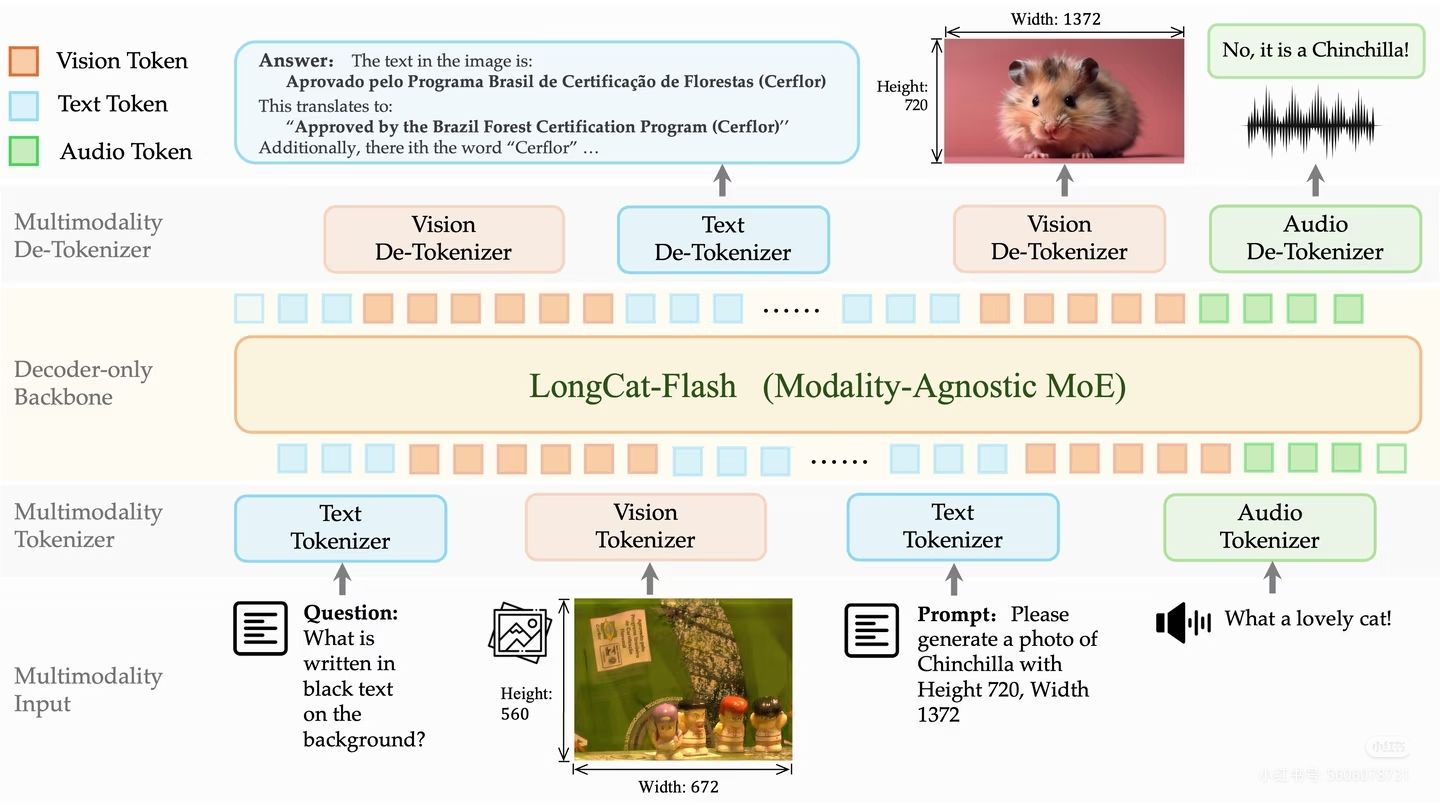
Meituan's technical team has officially announced the open-source release of LongCat-Next, a native multimodal model designed to bridge the gap between artificial intelligence and the physical world. By treating vision and speech as "native languages" rather than secondary inputs, LongCat-Next represents a significant step toward embodied intelligence. The release includes the core model and its specialized discrete tokenizer, aimed at providing developers with the tools necessary to build AI systems that can perceive, understand, and interact with real-world environments. This move underscores Meituan's commitment to advancing AI capabilities in physical spaces, offering a foundation for future innovations in how machines interpret and act upon visual and auditory data.
Key Takeaways
- Native Multimodality: LongCat-Next integrates vision and speech as core, "native" components of the AI's architecture.
- Open-Source Commitment: Meituan has released both the LongCat-Next model and its discrete tokenizer to the global developer community.
- Physical World Focus: The project is specifically designed to explore AI's ability to perceive and act within the physical world.
- Developer Empowerment: The release aims to enable the creation of AI that can move beyond digital data to understand real-world contexts.
In-Depth Analysis
Vision and Speech as Native Languages
The release of LongCat-Next by the Meituan technical team marks a shift in how multimodal AI is structured. The core philosophy behind this model is the transition of vision and speech from peripheral data types into what the developers describe as the AI's "mother tongue." In many traditional AI architectures, visual and auditory inputs are processed through separate encoders and then mapped to a text-based understanding. LongCat-Next seeks to move away from this translation-heavy approach by making these modalities native to the model's processing core. This native integration is intended to allow the AI to perceive the world more directly and intuitively, mirroring how biological entities process environmental stimuli.
Bridging the Gap to the Physical World
LongCat-Next is explicitly described as an exploration into the path of "Physical World AI." This focus suggests a move toward embodied intelligence—AI that is not confined to screens or text boxes but is capable of understanding the nuances of physical space. By open-sourcing the model, Meituan is providing a framework for AI that can potentially interact with its surroundings. The goal is to move beyond simple data recognition toward a deeper level of "perception, understanding, and action." This indicates that the model is designed not just to see or hear, but to use that information as a basis for interacting with the real world, which is a critical requirement for applications in robotics, logistics, and automated services.
The Role of the Discrete Tokenizer
A significant technical highlight of this announcement is the open-sourcing of the discrete tokenizer alongside the LongCat-Next model. In the context of multimodal models, a tokenizer is responsible for breaking down complex data—like images or audio waves—into discrete units that the model can process. By providing this specific tokenizer, Meituan is giving developers the exact tools used to achieve the model's native multimodal capabilities. This transparency allows for better fine-tuning and customization, enabling researchers to build more specialized applications that require high-fidelity interpretation of visual and auditory signals in diverse physical environments.
Industry Impact
The open-sourcing of LongCat-Next is likely to influence the AI industry by lowering the barrier to entry for physical-world AI research. As a major player in the technology and logistics sector, Meituan’s contribution provides a practical foundation for others to build upon. The emphasis on "native" multimodality challenges the industry to rethink how different data types are integrated, potentially leading to more efficient and responsive AI systems. Furthermore, by releasing these tools openly, Meituan fosters a collaborative ecosystem that could accelerate the development of AI capable of handling complex, real-world tasks that were previously limited by the constraints of text-centric models.
Frequently Asked Questions
Question: What makes LongCat-Next different from other multimodal models?
LongCat-Next is designed with vision and speech as its "native languages," meaning these modalities are integrated into the core of the model rather than being treated as secondary inputs. This is specifically aimed at improving the AI's ability to interact with the physical world.
Question: What components did Meituan open-source in this release?
Meituan has open-sourced the core LongCat-Next model and its discrete tokenizer, allowing developers to fully utilize and build upon the research team's work.
Question: What is the ultimate goal of the LongCat-Next project?
The goal is to enable developers to build AI systems that can truly perceive, understand, and act within the real, physical world, moving toward more advanced forms of embodied intelligence.