
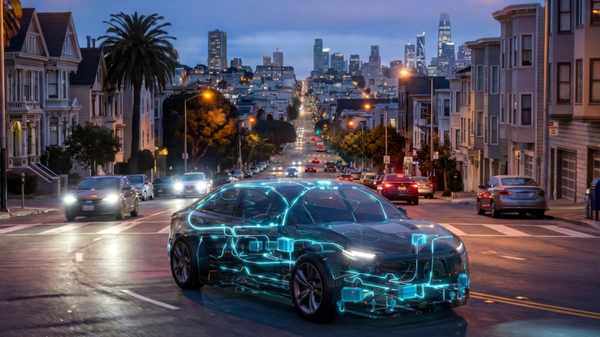
The Critical Shift in Autonomous Mobility: Why Robotaxi Safety Must Be Built-In Rather Than Bolted-On
As the robotaxi industry transitions from experimental prototype milestones to full-scale commercial operations, the architectural approach to safety has become the primary differentiator for success. Currently operating in dozens of cities, autonomous ride-hailing services are no longer a future concept but a present reality. This shift necessitates a move away from 'bolted-on' safety measures—auxiliary layers added to existing systems—toward 'built-in' safety, where security and reliability are integrated into the core hardware and software from the ground up. This analysis explores the expanding ecosystem of autonomous vehicles and the necessity of an integrated safety-first design to maintain public trust and ensure the long-term viability of driverless transportation in a rapidly evolving global market.
Key Takeaways
- Commercial Evolution: The robotaxi industry has successfully moved beyond the prototype phase into active commercial operations across dozens of global cities.
- Architectural Integrity: Safety in autonomous vehicles is most effective when it is "built-in" to the core system architecture rather than "bolted-on" as an afterthought or secondary layer.
- Ecosystem Expansion: The rapid growth of the autonomous ride-hailing ecosystem requires a standardized, foundational approach to safety to support scaling and multi-city deployments.
- Public Trust: The transition to driverless services, where passengers interact with an empty driver's seat, relies heavily on the underlying safety architecture to ensure reliability and consumer confidence.
In-Depth Analysis
From Prototype Milestones to Commercial Reality
According to Riccardo Mariani, the robotaxi industry has reached a pivotal juncture. For years, the sector was defined by technical milestones and the successful completion of limited prototype tests. However, the landscape has fundamentally changed. Today, in numerous urban centers, the experience of a car pulling up to the curb with no human driver is a functional reality. This transition from "prototype milestones" to "commercial operations" represents a significant maturation of autonomous vehicle (AV) technology.
As these services move into the commercial sphere, the stakes for operational consistency and safety are higher than ever. The "expanding ecosystem" mentioned in the industry's current trajectory includes not only the vehicles themselves but also the complex software stacks, remote management systems, and the regulatory frameworks that must evolve alongside the technology. This commercial phase demands a shift in focus from simply making a car drive itself to making a car drive itself safely, reliably, and profitably at scale.
The Philosophy of Built-In vs. Bolted-On Safety
The core challenge facing developers today is the methodology of safety integration. The distinction between "built-in" and "bolted-on" safety is critical for the future of autonomous mobility. "Bolted-on" safety refers to the practice of taking a standard vehicle or a basic autonomous system and adding layers of sensors, redundant software, or safety patches to address risks as they are identified. While this approach may suffice for early-stage testing, it often results in a fragmented architecture that can be difficult to validate and maintain as the system grows in complexity.
In contrast, "built-in" safety implies that every component of the robotaxi—from the silicon chips and the operating system to the high-level driving algorithms—is designed with safety as a primary functional requirement. By integrating safety into the very DNA of the vehicle's architecture, developers can ensure that the system is inherently resilient. This integrated approach allows for better handling of "edge cases"—rare or unexpected road scenarios—because the safety protocols are part of the core decision-making logic rather than a separate monitoring system trying to override a primary controller. For a robotaxi to operate without a human supervisor, this level of architectural cohesion is not just an advantage; it is a necessity.
Scaling Within an Expanding Ecosystem
The expansion of robotaxi services into dozens of cities highlights the need for a scalable safety model. An "expanding ecosystem" implies a variety of operating environments, weather conditions, and local traffic laws. A "bolted-on" safety strategy is difficult to scale because each new environment might require new patches or specific adjustments to the safety layer.
However, a "built-in" safety architecture provides a robust foundation that can be more easily adapted to different regions. When the core operating system and hardware are designed for safety, the system's reliability remains constant even as the operational design domain (ODD) expands. This scalability is what will allow the industry to move from dozens of cities to hundreds, making autonomous ride-hailing a global standard for urban transportation. The focus on built-in safety ensures that as the ecosystem grows, the safety standards do not dilute but rather become more reinforced through standardized architectural practices.
Industry Impact
The shift toward built-in safety architectures will have a profound impact on the AI and automotive sectors. Firstly, it establishes a new benchmark for regulatory compliance. Governments and safety boards are likely to favor systems that can demonstrate safety-by-design, potentially leading to faster certification for companies that adopt this integrated approach.
Secondly, this philosophy influences the entire supply chain. Chipmakers, sensor manufacturers, and software developers must now align their products with these integrated safety standards. This alignment fosters a more mature industry ecosystem where components are designed to be interoperable and safety-aware from the start. Finally, the emphasis on built-in safety is the most effective way to build and maintain public trust. As the "Your ride is here" experience becomes common, the industry's ability to prove that safety is an inseparable part of the vehicle's architecture will be the key driver for widespread consumer adoption and the ultimate displacement of traditional ride-hailing models.
Frequently Asked Questions
Question: What does it mean for safety to be "built-in" in a robotaxi?
Built-in safety means that the safety protocols, redundancies, and risk-management logic are integrated into the fundamental design of the vehicle's hardware and software. It is not an added layer but a core part of how the system functions from the ground up, ensuring higher reliability and better handling of complex driving scenarios.
Question: How has the robotaxi industry changed recently according to the news?
The industry has moved from a phase of reaching technical prototype milestones to a phase of active commercial operations. It is now a reality in dozens of cities where users can hail driverless cars through apps, signaling that the technology is ready for real-world business use and is no longer just in the testing stage.
Question: Why is the "bolted-on" safety approach considered insufficient for commercial scaling?
A bolted-on approach often involves adding safety features to a system that wasn't originally designed for full autonomy. This can lead to architectural complexities, difficulties in system validation, and potential vulnerabilities when the vehicle encounters unexpected situations. For commercial scaling, a more unified and integrated safety architecture is required to ensure consistent performance across different environments.


