Managing AI Coding Through Agent Evaluation: A Case Study of Refactoring 310,000 Lines of Code
As AI begins to generate over 90% of code, the focus of software engineering is shifting from the speed of generation to the necessity of constraining AI capabilities to prevent systemic chaos. This article explores the Meituan technical team's experience in refactoring 310,000 lines of code using an Agent evaluation approach. By implementing technical debt sorting, rule construction, standardized operating procedures (SOPs), and a Pre-PR mechanism, the team successfully transformed high-cost refactoring into a sustainable, daily iterative process. The core philosophy emphasizes that without unified standards, AI-driven development can amplify technical debt, making structured management and rigorous evaluation essential for long-term system stability and code quality in the era of AI coding.
Key Takeaways
- Shift in Focus: In an environment where over 90% of code is AI-generated, the primary challenge is no longer the speed of production but the ability to constrain and manage AI capabilities.
- Risk of Chaos: Without unified standards and strict rules, AI has the potential to exponentially increase technical debt and systemic disorder.
- Methodological Framework: Successful management of AI coding involves four pillars: technical debt sorting, rule construction, refactoring SOPs, and a Pre-PR mechanism.
- Operational Efficiency: By integrating these practices, large-scale refactoring (such as the 310,000-line project) transitions from a high-cost specialized task to a continuous, daily iterative action.
In-Depth Analysis
The Challenge of AI-Generated Code at Scale
The current landscape of software development is undergoing a fundamental transformation, with AI now capable of generating more than 90% of the code in certain production environments. However, this increase in speed brings a significant risk: the amplification of chaos. The Meituan technical team identifies that the critical factor determining a system's trajectory is no longer how fast code is written, but how effectively the AI's output is constrained. Without a unified framework or set of specifications, AI tools can inadvertently create complex, unmanageable codebases by replicating and scaling existing inefficiencies or inconsistencies. This necessitates a shift in management philosophy from "productivity-first" to "constraint-and-quality-first."
Strategic Framework for AI Refactoring
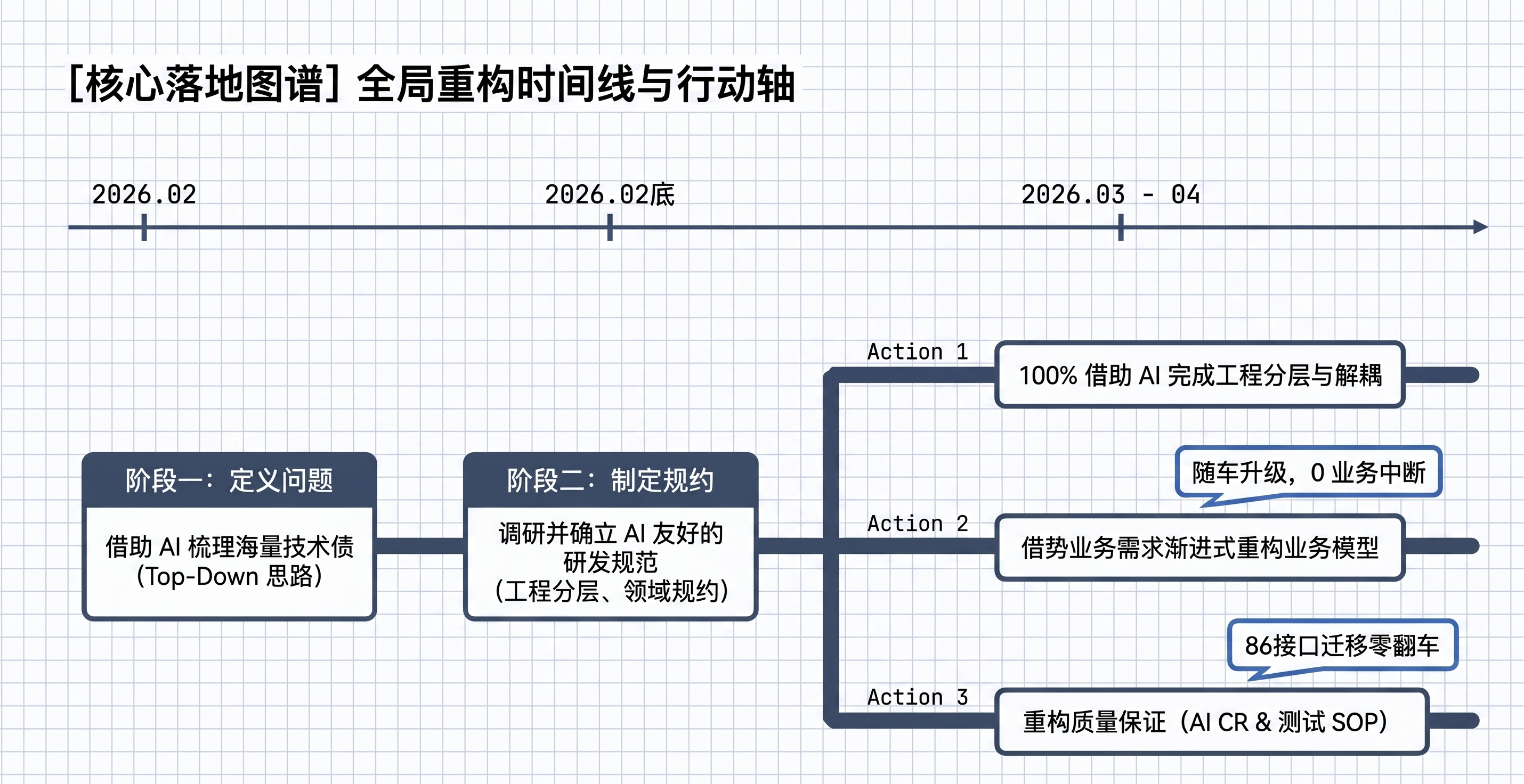
To address the challenges of large-scale AI-driven development, the team executed a massive refactoring project involving 310,000 lines of code. This was not approached as a traditional manual cleanup but through the lens of "Agent evaluation thinking." The strategy was built upon several key technical components:
- Technical Debt Sorting: Identifying and categorizing existing issues within the codebase to prioritize areas for AI intervention.
- Rule Construction: Establishing clear, programmable constraints and standards that the AI must follow to ensure consistency across the project.
- Refactoring SOP (Standard Operating Procedure): Creating a repeatable, standardized workflow for AI agents to follow during the refactoring process, reducing the likelihood of human or machine error.
Operationalizing Continuous Improvement
A pivotal element of this practice is the implementation of a Pre-PR (Pull Request) mechanism. This mechanism acts as a gatekeeper, ensuring that code refactoring and quality checks are performed before changes are merged into the main branch. By embedding these checks into the standard development lifecycle, the team successfully moved away from the model of "high-cost专项" (high-cost specialized projects). Instead, refactoring has become a "daily action" that occurs naturally alongside regular feature iterations. This approach ensures that the codebase remains healthy and manageable even as the volume of AI-generated code continues to grow.
Industry Impact
The practices shared by the Meituan technical team signal a significant evolution in the field of AI-assisted software engineering (AI Coding). As AI becomes the primary author of code, the role of the human developer and the technical manager evolves into that of an architect and an evaluator. The industry must move toward standardized "Agent evaluation" frameworks to ensure that AI tools contribute to system health rather than technical decay. This case study demonstrates that with the right constraints—specifically through SOPs and automated mechanisms like Pre-PR—large-scale technical debt can be managed systematically, setting a precedent for how modern enterprises handle AI-driven codebases.
Frequently Asked Questions
Question: Why is speed no longer the most important metric in AI coding?
When AI generates over 90% of the code, the volume of output is so high that any lack of standardization is magnified. If the AI is not constrained by unified rules, it will amplify chaos and technical debt faster than humans can fix it, making management and constraints more critical than raw generation speed.
Question: How does the Pre-PR mechanism help in managing AI code?
The Pre-PR mechanism ensures that refactoring and adherence to rules are checked before code is integrated. This transforms refactoring from a massive, one-time project into a continuous, daily activity that happens during every iteration, maintaining code quality in real-time.
Question: What is the significance of "Agent evaluation thinking" in this context?
It refers to treating the AI coding tool as an autonomous agent that needs to be managed through rigorous evaluation, clear rules, and standardized procedures (SOPs), rather than just a simple autocomplete tool. This ensures the agent's output aligns with the long-term technical health of the system.