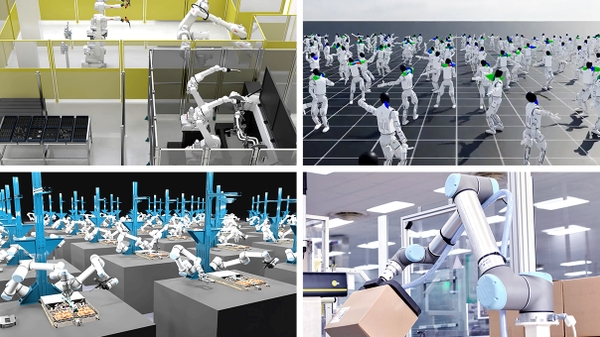
NVIDIA Partners with Global Robotics Ecosystem to Advance Production-Scale Physical AI
NVIDIA has announced a major strategic initiative to bring physical AI into the real world by partnering with the global robotics ecosystem. This comprehensive collaboration includes leading robot brain developers, industrial robotics giants, and pioneers in humanoid technology, all united to power production-scale physical AI. To support this ambitious real-world transition, NVIDIA officially unveiled new NVIDIA Isaac™ simulation frameworks, alongside the introduction of new NVIDIA Cosmos™ and NVIDIA Isaac GR00T open models. These advanced technological tools are specifically designed to empower the industry to seamlessly develop, train, and deploy the next generation of intelligent robots, marking a pivotal step in the evolution of robotic capabilities.
Key Takeaways
- Ecosystem Collaboration: NVIDIA is actively partnering with the global robotics ecosystem to transition physical AI into real-world applications.
- Diverse Partnerships: The strategic initiative includes collaborations with leading robot brain developers, industrial robot giants, and humanoid pioneers.
- Production-Scale Focus: The primary objective of these partnerships is to power production-scale physical AI, moving beyond mere conceptual frameworks.
- New Simulation Tools: NVIDIA has officially unveiled new NVIDIA Isaac™ simulation frameworks to aid in the creation of intelligent machines.
- Open Models Introduced: The company introduced new NVIDIA Cosmos™ and NVIDIA Isaac GR00T open models to support the industry.
- Comprehensive Lifecycle Support: The newly announced tools are designed to support the entire robotic lifecycle: enabling the industry to develop, train, and deploy the next generation of intelligent robots.
In-Depth Analysis
Uniting the Global Robotics Ecosystem for Physical AI
The recent announcement from NVIDIA highlights a significant strategic pivot toward the tangible, real-world application of artificial intelligence, specifically categorized as "physical AI." By explicitly stating the goal to take physical AI to the "real world," NVIDIA is signaling a transition from digital-only AI applications to embodied intelligence. To achieve this, NVIDIA is not acting in isolation; rather, the company is forging deep partnerships across the entire global robotics ecosystem.
The text categorizes these essential partners into three distinct groups, each representing a critical pillar of the robotics industry. First, the inclusion of "leading robot brain developers" indicates a focus on the cognitive, processing, and decision-making software that serves as the central intelligence of modern machines. Second, the partnership with "industrial robot giants" demonstrates a commitment to integrating these advanced AI capabilities into established, heavy-duty manufacturing and industrial environments where scale and reliability are paramount. Finally, the collaboration with "humanoid pioneers" showcases an investment in the cutting-edge frontier of robotics, focusing on machines designed to navigate and operate within environments built for humans. Together, these three groups encompass the full spectrum of robotic development required to achieve what NVIDIA terms "production-scale physical AI."
The Unveiling of Advanced Simulation Frameworks and Open Models
To facilitate this massive industry-wide shift toward production-scale physical AI, NVIDIA has introduced a suite of new technological tools designed to serve as the foundational infrastructure for robotic development. A critical component of this release is the new NVIDIA Isaac™ simulation frameworks. In the context of robotics, simulation frameworks are essential for creating highly accurate virtual environments where physical AI can be tested and refined safely before interacting with the real world.
Furthermore, NVIDIA has expanded its offerings by unveiling new open models specifically tailored for the robotics industry. The announcement highlights two distinct models: the new NVIDIA Cosmos™ and the NVIDIA Isaac GR00T open models. By designating these as "open models," NVIDIA is providing the broader industry with accessible, foundational AI architectures that can be adapted and utilized by various developers and manufacturers. These models are intended to serve as the underlying intelligence structures that will power the diverse array of robots being built by NVIDIA's ecosystem partners.
The "Develop, Train, and Deploy" Lifecycle
The ultimate purpose of unveiling the NVIDIA Isaac simulation frameworks, alongside the Cosmos and Isaac GR00T open models, is explicitly defined in the announcement: to empower the industry to "develop, train and deploy" the next generation of intelligent robots. This three-step methodology outlines a comprehensive lifecycle for physical AI.
The "develop" phase relies on the foundational open models (Cosmos and GR00T) to build the core intelligence and capabilities of the robot. The "train" phase heavily utilizes the newly unveiled NVIDIA Isaac simulation frameworks, allowing the AI to learn, adapt, and optimize its behaviors in a risk-free, simulated environment. Finally, the "deploy" phase represents the culmination of the partnership's goal—taking the fully trained physical AI and integrating it into the real world at a production scale. By providing tools that address every stage of this lifecycle, NVIDIA is positioning itself as the central technological provider for the future of intelligent robotics.
Industry Impact
The announcement of NVIDIA's comprehensive partnerships and new technological tools carries profound implications for the artificial intelligence and robotics industries. By focusing on "production-scale physical AI," the industry is moving closer to an era where intelligent robots are no longer confined to research laboratories or limited pilot programs, but are instead deployed widely across various sectors in the real world.
The strategic alignment with robot brain developers, industrial giants, and humanoid pioneers ensures that the advancements in physical AI will be applied across a highly diverse range of form factors and use cases—from factory floors to human-centric environments. Furthermore, the introduction of the NVIDIA Cosmos and NVIDIA Isaac GR00T open models is likely to accelerate the pace of innovation across the industry. By providing open access to these advanced models, alongside the robust NVIDIA Isaac simulation frameworks, NVIDIA is significantly lowering the barrier to entry for developing complex, next-generation intelligent robots. This comprehensive ecosystem approach ensures that the entire pipeline—from initial software development and virtual training to real-world physical deployment—is supported by a unified technological foundation.
Frequently Asked Questions
Question: What is the primary goal of NVIDIA's new partnerships in the robotics sector?
Answer: The primary goal of NVIDIA's partnerships with the global robotics ecosystem is to power production-scale physical AI and take it into the real world.
Question: Who is NVIDIA partnering with to achieve its physical AI objectives?
Answer: NVIDIA is partnering with a diverse global robotics ecosystem that specifically includes leading robot brain developers, industrial robot giants, and humanoid pioneers.
Question: What specific new technologies did NVIDIA unveil for the robotics industry?
Answer: NVIDIA officially unveiled new NVIDIA Isaac™ simulation frameworks, as well as new NVIDIA Cosmos™ and NVIDIA Isaac GR00T open models.
Question: How are the newly unveiled NVIDIA tools intended to be used by the industry?
Answer: The new simulation frameworks and open models are designed for the industry to develop, train, and deploy the next generation of intelligent robots.