Lingo.dev v1
Lingo.dev: The Advanced Localization Engineering Platform for Consistent, Infrastructure-Driven Product Translations.
Lingo.dev is a professional localization engineering platform that transforms translation into stateful infrastructure. By utilizing localization engines that persist glossaries, brand voice, and model chains, Lingo.dev enables developers to integrate context-aware translations via API, CLI, and CI/CD, reducing terminology errors by 59% through Retrieval Augmented Localization.
2026-05-09
14.0K
Lingo.dev v1 Product Information
Lingo.dev: The Professional Localization Engineering Platform
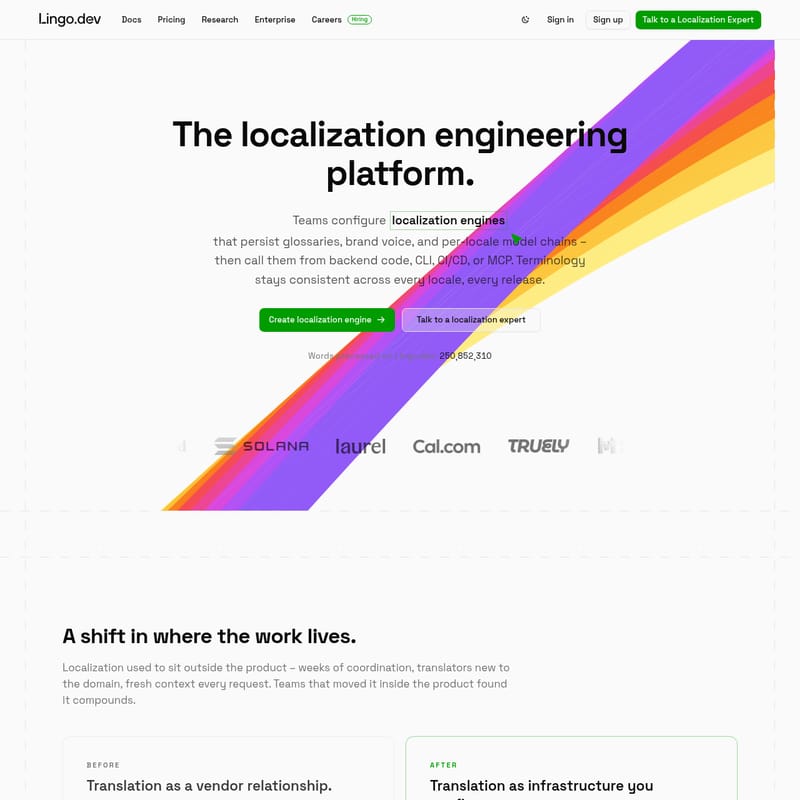
Lingo.dev is a revolutionary localization engineering platform designed to move translation from an external, disconnected process directly into the product infrastructure. Traditionally, localization has lived outside the core product workflow, leading to weeks of coordination and terminology drift. Lingo.dev changes this by allowing teams to configure localization engines that persist glossaries, brand voice, and per-locale model chains, ensuring that terminology stays consistent across every release and every locale.
What is Lingo.dev?
Lingo.dev is a stateful translation infrastructure that treats localization as a technical primitive rather than a vendor relationship. Before Lingo.dev, translation requests often left the product environment, where vendors would translate without domain knowledge, causing quality to suffer and terminology to drift over time.
With Lingo.dev, translation becomes infrastructure you configure. The platform hosts a localization engine that holds your specific glossary, brand voice, and model chain. Every request enters the product with this context already attached, locking in terminology and tracking quality dimensions over time. As Pete Koomen, Group Partner at Y Combinator, notes: "Lingo.dev's approach reminds me of how Stripe revolutionized payments—making a complex process invisible to developers."
Core Features of Lingo.dev
The Localization Engine: A Stateful API
The heart of the platform is the localization engine. It is a stateful translation API that persists domain context across every request. Unlike traditional APIs that treat every request as a fresh guess, the Lingo.dev localization engine uses:
- Glossary Enforcement: Matches terms by semantic similarity per locale pair.
- Brand Voice Configuration: Defines the register, tone, and formality per locale.
- Model Chain: Selects ranked providers with automatic fallback mechanisms.
- AI Reviewers: Independent scorers that evaluate quality per dimension.
Retrieval Augmented Localization (RAL)
One of the most powerful features of Lingo.dev is Retrieval Augmented Localization (RAL). Traditional methods often re-localize the entire product (which is wasteful) or re-localize only changed strings (which lacks context). RAL is the "third way." It re-localizes only what changed while retrieving matching context per request.
By running a similarity search against your glossary and injecting matching terms at inference time, Lingo.dev reduces terminology errors by 59% on the hardest cases, such as regulatory prose. This ensures that the word "provider" is always translated correctly based on your product context, rather than the model making a generic guess.
Developer-First Tooling
Lingo.dev provides four primary surfaces for developers to interact with their localization engine:
- Lingo API: Allows for synchronous and asynchronous translation via HTTP with webhook delivery.
- Lingo React MCP: AI agents that configure engines and translate directly within the IDE.
- Lingo CLI: Supports 14 file formats, allowing for the first translated build in as little as 4 minutes.
- Lingo GitHub Action: Triggers translations on every push and includes localized strings in Pull Requests.
How to Use Lingo.dev
Integrating Lingo.dev into your workflow is straightforward, turning complex localization into a few lines of code.
Step 1: Create and Configure
Teams start by creating a localization engine on the platform. This involves setting up your glossary, defining your brand voice, and choosing your model chain.
Step 2: Call the API
You can call the engine directly from your backend code. For example, a simple POST request to the Lingo.dev API looks like this:
POST /process/localize
Header: X-API-Key: $LINGO_API_KEY
Body: { "engineId": "eng_abc123", "sourceLocale": "en", "targetLocale": "de", "data": { "cta": "Get started" } }
The engine returns the localized data (e.g., "Jetzt starten") with the context of your glossary already applied.
Step 3: Automate via CI/CD
By adding the Lingo GitHub Action, every push to your repository can trigger a translation job. The localization engine handles the heavy lifting, and the results are delivered directly to your PRs.
The Professional Localization Pipeline
Every asynchronous job on Lingo.dev runs through a sophisticated 6-step pipeline to ensure maximum quality:
- Source Refinement: An LLM pre-processes source text to resolve ambiguities and fix placeholder issues.
- Context Enrichment: Uses cosine similarity over vector embeddings to match source terms to your glossary.
- LLM Translation: The model translates using the enriched context (glossary, brand voice, and instructions).
- Human Post-Editing: An optional step where a network of qualified translators reviews the output if your quality rules require it.
- LLM Post-Review: A second independent model scores the translation for fluency and accuracy.
- Delivery: Results are sent via webhook or streamed over WebSocket for real-time applications.
Use Cases
Lingo.dev is built to scale across different organizational needs:
- Per Tenant: SaaS platforms can provision a unique localization engine for every customer, allowing each tenant to have their own custom glossary and brand voice.
- Per Surface: Use separate engines for different content types. Marketing copy, legal boilerplate, and product UI can each have their own isolated glossary and quality rules.
- At Scale: Run thousands of engines via API. Lingo.dev handles the model routing, storage, and scoring, making it a first-class infrastructure primitive for enterprise-grade applications.
FAQ
Q: How does Lingo.dev reduce terminology errors?
A: By using Retrieval Augmented Localization (RAL). The platform decomposes the input, runs a similarity search against your unique glossary, and injects the correct terms into the context window at inference time. Research shows this reduces errors by up to 59%.
Q: Can I involve human translators in the process?
A: Yes. Lingo.dev includes an optional Human Post-Editing step managed entirely behind the API. You can configure triggers based on quality scores, and the platform routes content to qualified translators automatically.
Q: Is Lingo.dev secure for enterprise use?
A: Absolutely. Lingo.dev is SOC 2 Type II audited, offers 99.9% Uptime SLAs, and features AES-256 encryption at rest with TLS in transit. Data residency options are available for both EU and US regions.
Q: What developer tools are supported?
A: Lingo.dev offers an HTTP API, a CLI supporting 14 file formats, a GitHub Action for CI/CD, and an MCP for IDE integration.
Q: Does Lingo.dev handle multiple languages independently?
A: Yes. Each locale in a job completes independently, and failure isolation ensures that an issue in one language does not stall the entire pipeline.