Graphbit PRFlow
PRFlow: AI-Powered PR Review Agent for Automated Security Analysis and Cross-File Dependency Tracking
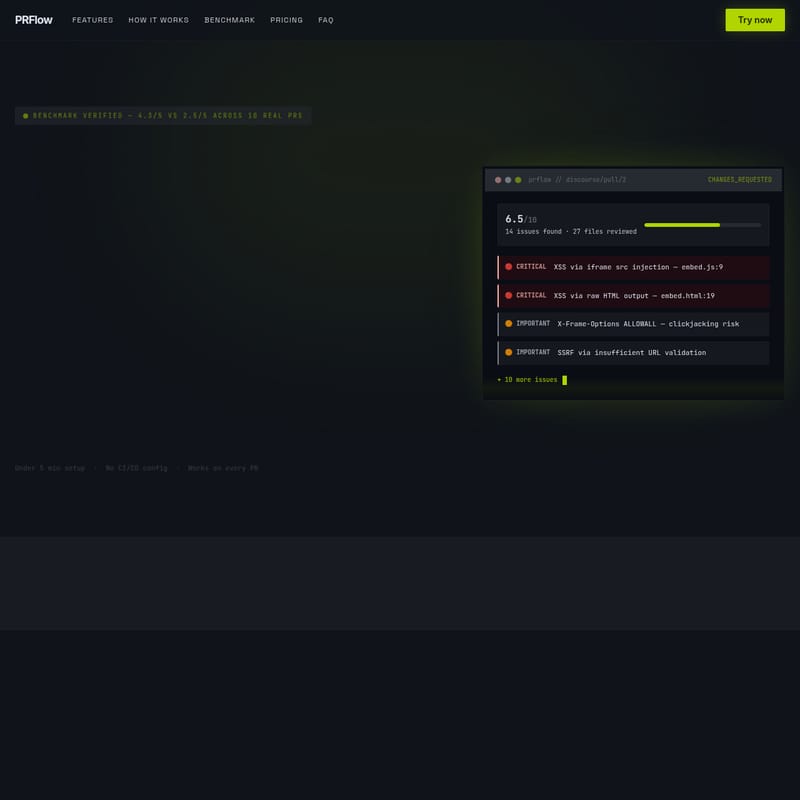
PRFlow is a high-performance AI reviewer that indexes your entire codebase to find critical bugs and security vulnerabilities. It delivers structured reviews in under three minutes, tracing data flow across files to catch XSS, SSRF, and auth bypasses. Featuring persistent learning and a pay-per-review model, PRFlow ensures high-quality code without seat-based pricing.
2026-05-13
2.0K
Graphbit PRFlow Product Information
PRFlow: The Next Generation of AI-Driven PR Reviews and Security Analysis
In the fast-paced world of software development, the manual code review process is often a bottleneck that can lead to missed vulnerabilities and architectural inconsistencies. Enter PRFlow, the only AI reviewer specifically architected to find the bugs that actually ship. By indexing your entire codebase and tracing complex cross-file dependencies, PRFlow transforms how engineering teams handle pull requests. Unlike traditional static analysis tools, PRFlow provides a deep, structured security review in under three minutes, automatically triggered on every PR.
What's PRFlow?
PRFlow is a sophisticated AI-powered code review agent designed to perform deep semantic analysis of pull requests. While most AI tools simply look at the code diff, PRFlow understands the broader context of your repository. It acts as an expert secondary reviewer that specializes in security-first assessments, catching critical issues like XSS, SSRF, and authentication bypasses that often span multiple files.
PRFlow has been benchmarked against real-world scenarios, achieving a verified score of 4.3/5 compared to the industry average of 2.5/5. It is built for senior engineers who require depth, accuracy, and a tool that learns from their team's specific coding standards and feedback.
Key Features of PRFlow
PRFlow is packed with advanced capabilities that go beyond simple syntax checking. Its architecture is engineered for the complexity of modern, large-scale codebases.
Semantic Codebase Memory
PRFlow does not just read your PR in isolation. It indexes cross-repo dependencies and internal patterns using a Qdrant vector database. This means the AI knows your codebase before it even begins reading the pull request, allowing it to spot inconsistencies with existing architectural patterns.
Persistent Learning and Feedback Loops
One of the standout features of PRFlow is its ability to grow smarter over time. It corrects its behavior based on your team's feedback. When a developer provides a correction in a PR thread, PRFlow remembers that correction forever and applies it globally to future reviews, ensuring the same mistake is never flagged twice and the same standard is always upheld.
Smart Context Extraction
To ensure high accuracy without overwhelming the LLM, PRFlow utilizes smart context extraction. Instead of sending the entire file or just the raw diff, it identifies the exact function or class boundary that changed. It then bundles this with relevant cross-file dependencies, providing the AI with exactly the right amount of context to make an informed decision.
Security-First Review Logic
PRFlow is designed to catch high-severity vulnerabilities. By tracing how code flows across various files—rather than just looking at isolated lines—it can identify:
- XSS (Cross-Site Scripting)
- SSRF (Server-Side Request Forgery)
- SQL Injection (SQLi)
- Auth Bypasses
- Race Conditions
Single-Pass Efficiency
Speed is critical in a CI/CD pipeline. PRFlow reads the whole PR in a single pass and produces a complete structured review—including a health score, identified issues, strengths, and suggested fixes—in just 1 to 3 minutes.
How PRFlow Works: The Pipeline
PRFlow operates through a sophisticated six-step pipeline to ensure every review is accurate and actionable.
- Webhook Received: As soon as a PR is opened or updated, an HMAC-SHA256 validated webhook triggers the process. An acknowledgment comment is posted immediately so developers know the review is underway.
- File Classification: PRFlow categorizes every file (source code, config, binary, etc.). It intelligently skips auto-generated files like lockfiles and migrations to focus on human-written code.
- Scope Extraction: For major languages including Python, TS, JS, Go, Java, Rust, C#, and Ruby, the agent identifies the precise functional boundaries of the changes.
- Cross-File Enrichment: If a changed function calls a utility in another file, PRFlow pulls in those references. This is how it catches an XSS vulnerability that might span three different files.
- Memory Retrieval: The system queries the Qdrant vector DB for past feedback and team standards, ensuring the review aligns with your specific repository history.
- Review Posted: The final review is injected directly as inline GitHub PR comments, featuring severity ratings (Critical, Important) and direct code fix suggestions.
Use Cases for PRFlow
PRFlow is versatile enough to be used across various engineering workflows:
- Automated Security Auditing: Use PRFlow as a gatekeeper to catch critical src injection or raw HTML output issues before they reach production.
- Onboarding New Developers: Use the persistent learning feature to enforce coding standards automatically, helping new hires align with team preferences without constant manual oversight.
- Complex Refactoring: When changing shared utilities, PRFlow's cross-file enrichment ensures that side effects in dependent files are flagged and reviewed.
- High-Velocity Shipping: For teams that push code frequently, the <3 minute turnaround time ensures that security does not come at the cost of speed.
How to Use PRFlow
Setting up PRFlow is designed to be frictionless. There are no complex CI/CD configurations or GitHub Actions to manage manually. You can be up and running in under five minutes.
- Create an Account: Visit platform.graphbit.ai to initialize your account.
- Install from Marketplace: Navigate to the GitHub Marketplace, find PRFlow, and install it. You can select specific repositories or your entire organization.
- Connect and Review: Use the CLI or the web interface to connect your provider. Once connected, simply open any pull request. PRFlow will automatically post its first review within minutes.
"PRFlow is live and ready to review. Open any PR to receive your first automated security analysis."
Pricing Model
PRFlow moves away from traditional seat-based pricing. Instead, it uses Graphbit Coins (GC), allowing you to pay for what you actually use. This is ideal for scaling organizations where headcount may fluctuate, but code quality remains a priority.
- Core Tier: Starting at $25 for 1k GC, perfect for high-growth engineering squads. Includes all features and all languages.
- Elite Tier: Designed for mission-critical scaling orgs, offering priority queue processing and higher API rate limits.
- Typical Usage: A standard PR review costs approximately 1,500 coins.
FAQ
How is PRFlow different from CodeRabbit?
While tools like CodeRabbit provide general reviews, PRFlow is engineered for depth and security. In head-to-head benchmarks (such as Sentry PR #8), PRFlow found 7 critical issues where competitors found 0. PRFlow focuses on cross-file data flow and has a verified public benchmark of 4.3/5.
What languages does PRFlow support?
PRFlow offers deep support for 8 major languages: Python, TypeScript, JavaScript, Go, Java, Rust, C#, and Ruby.
How fast is a review?
Typically, a full structured review is posted as inline comments within 1 to 3 minutes of the PR being opened or updated.
Does PRFlow review auto-generated files?
No. PRFlow automatically identifies and skips auto-generated files such as lockfiles and migrations to ensure the review focuses only on relevant code changes.
Is my source code secure?
Yes. PRFlow is enterprise-ready, SOC2 compliant, and uses Git-native authentication to ensure your codebase remains private and secure.
Can PRFlow learn my team's coding standards?
Yes. Through its persistent learning and memory retrieval system, any feedback you give to PRFlow via PR comments is stored and applied to all future reviews in that repository.