display.dev
display.dev: A Gated Publishing Engine for Securely Sharing AI-Generated HTML Artifacts
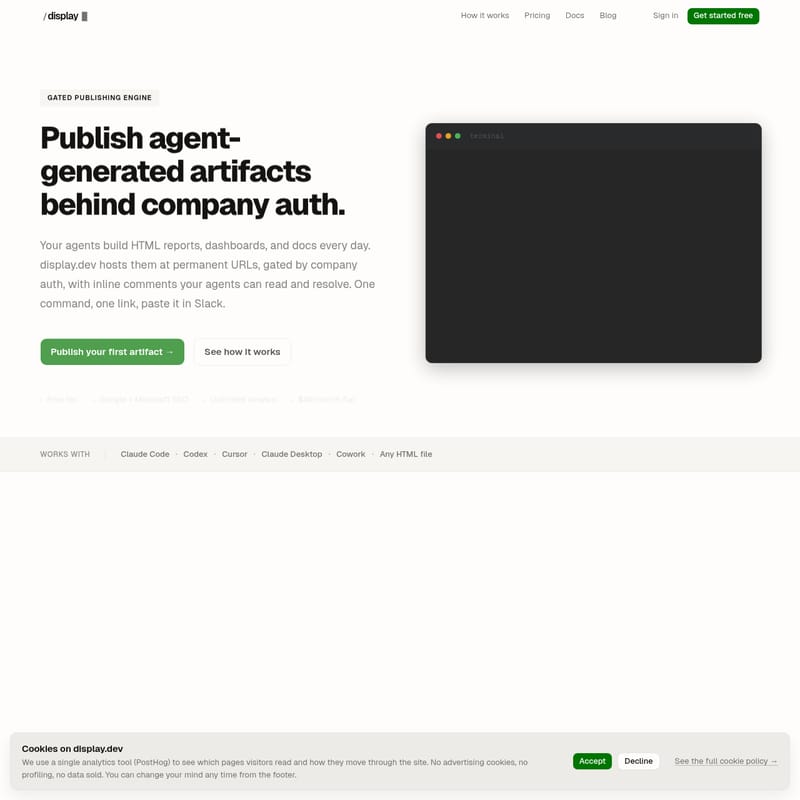
display.dev is a specialized gated publishing engine designed to help teams share agent-generated artifacts, such as HTML reports, interactive dashboards, and documentation, behind secure company authentication. By integrating seamlessly with tools like Claude Code, Cursor, and Codex, display.dev enables users to publish artifacts via CLI, MCP, or web upload, generating permanent URLs protected by Google or Microsoft SSO. Unlike traditional hosting platforms that charge per viewer, display.dev offers flat-rate pricing with unlimited viewers, ensuring that interactive content remains secure and accessible to stakeholders across the organization without the high costs of enterprise-tier alternatives.
2026-05-14
5.0K
display.dev Product Information
display.dev: The Professional Gated Publishing Engine for AI-Generated Artifacts
In the modern development workflow, AI agents are increasingly capable of generating sophisticated HTML reports, interactive dashboards, and complex documentation. However, sharing these agent-generated artifacts remains a significant hurdle for teams. Traditional methods often result in broken layouts, lost interactivity, or security risks. display.dev solves this problem by providing a dedicated gated publishing engine that allows you to host and share these artifacts behind secure company authentication in seconds.
What is display.dev?
display.dev is a specialized gated publishing engine designed to bridge the gap between AI generation and team collaboration. When your agents (such as Claude Code, Codex, or Cursor) build HTML files, display.dev hosts them at permanent URLs gated by your company's SSO (Single Sign-On). It transforms static, difficult-to-share files into living documents where teammates can leave inline comments that your agents can actually read and resolve.
Unlike standard hosting services, display.dev focuses specifically on the outputs of AI agents, ensuring that JavaScript, CSS, and interactive elements like D3 charts remain fully functional while staying protected from public access.
Key Features of display.dev
Secure Company Authentication (SSO)
Security is the core of the display.dev experience. Every artifact published is gated by your company’s existing infrastructure. Viewers sign in using the Google or Microsoft accounts they already use for work. This eliminates the need for IT tickets or new account creation while ensuring that sensitive data never reaches a public URL.
Seamless Integration with AI Agents
display.dev is built to work with the tools developers already use. It supports:
- Claude Code
- Codex
- Cursor
- Claude Desktop
- Any standard HTML or Markdown file
Interactive Feedback Loops
One of the standout features of this gated publishing engine is the two-way collaboration loop. Teammates can drop inline comments directly on the artifact. Because display.dev supports MCP (Model Context Protocol), your agent can read these comments, update the artifact, and resolve the thread—all at the same permanent URL.
Flat-Rate Pricing with Unlimited Viewers
Most hosting platforms charge per user seat, which becomes prohibitively expensive when sharing a report with an entire department. display.dev offers unlimited viewers on every tier. Whether you are sharing with five people or five hundred, your costs remain predictable.
Full HTML Fidelity
Many wiki tools or document editors strip out JavaScript or complex CSS, breaking the interactivity of agent-generated artifacts. display.dev maintains full fidelity, ensuring that live filters, hover states, and interactive layouts work exactly as intended.
How to Use display.dev
Getting your agent-generated artifacts from your local environment to your team is a streamlined four-step process.
1. Generate Your Artifact
Use your preferred AI agent—be it Claude Code, Cursor, or Codex—to build your HTML file, dashboard, or report. If it’s HTML or Markdown, display.dev can host it.
2. Publish to the Gated Publishing Engine
You have three primary ways to publish:
- CLI: Run
dsp publish ./your-file.htmlfrom your terminal. - MCP: Simply tell your agent in Claude Desktop, "publish this to my team."
- Web Upload: Use the drag-and-drop interface on the display.dev website for a no-setup experience.
3. Share the Permanent URL
Once published, you receive a permanent link. You can paste this URL into Slack, Notion, or email. Your teammates click the link, authenticate via SSO, and view the content immediately.
4. Comment and Iterate
Stakeholders leave feedback via inline comments. Your agent reads the feedback through the MCP integration, makes the necessary code changes, and republishes. The updated version appears at the same link, keeping the project history clean.
Common Use Cases
display.dev is versatile enough to handle any artifact your agent produces. Common use cases include:
- Technical Specs and Docs: Share detailed architectural plans without losing formatting.
- Interactive Dashboards: Host D3.js or other JS-heavy data visualizations for executive reviews.
- Code Reviews: Present complex code changes in a readable, interactive HTML format.
- Design Prototypes: Share live layouts with hover states and functional navigation with your design and product teams.
- Quarterly Reports: Distribute data-rich reports that stay secure behind company auth.
Competitive Comparison: Why Choose display.dev?
When comparing the cost of sharing a single HTML artifact with 100 viewers behind company SSO, the price gap between display.dev and other platforms is significant:
| Product | Monthly Cost | Notes | | :--- | :--- | :--- | | display.dev Pro | $49 | Real SSO, Unlimited Viewers, CLI + MCP | | Vercel Pro + SSO | $320+ | Requires Git projects; no simple file upload | | Cloudflare Pages | ~$700 | Per-seat pricing ($7/seat); no MCP support | | GitHub Pages (Private) | $2,100 | Requires Enterprise Cloud; viewers need GH accounts | | DIY (S3 + Cognito) | ~$20 + labor | High maintenance and setup time; no agent integration |
Frequently Asked Questions (FAQ)
Do viewers need to sign up for a display.dev account?
No. Viewers simply use their existing Google or Microsoft work accounts. If their email domain matches your company, they are granted access automatically.
How is this different from Claude's "Publish" button?
Claude’s native publish feature creates a public URL that anyone can see. display.dev provides a gated publishing engine that restricts access specifically to your company domain, ensuring sensitive data remains private.
Does display.dev work with non-AI tools?
Yes. While it is optimized for agent-generated artifacts, the CLI can publish any HTML or Markdown file, regardless of how it was created.
What kind of audit logs are provided?
Paid plans include detailed audit logs and view counts. You can see exactly who accessed which artifact and when, which is essential for compliance and tracking.
Why is the free plan limited to 10 gated artifacts?
Maintaining secure authentication infrastructure requires significant resources. The free tier allows you to evaluate the gated publishing engine with 10 private artifacts and unlimited public artifacts before upgrading to a paid plan for unlimited sharing.
Pricing Plans
- Free ($0/mo): Includes 10 gated artifacts, unlimited public artifacts, and 50MB storage.
- Solo ($15/mo): Designed for individuals needing unlimited gated sharing with 1GB storage and version history.
- Pro ($49/mo): The most popular plan for teams. Includes Google + Microsoft SSO, 25GB storage, 50 versions, and 90 days of audit logs.
- Enterprise (From $499/mo): For compliance-driven organizations requiring custom storage, unlimited versions, and 365 days of audit logs.
display.dev ensures your agent outputs are never degraded by screenshots or lost in Slack threads. Give your agent-generated artifacts a permanent, authenticated home today.