Claude Sonnet 5
Claude Sonnet 5: The Most Agentic and Efficient AI Model for Software Engineering and Enterprise Automation
Claude Sonnet 5 is a groundbreaking AI model designed for high-level agency, offering autonomous planning and tool use. It bridges the gap between cost-efficiency and top-tier performance, rivaling Opus-class capabilities.
2026-07-03
22435.7K
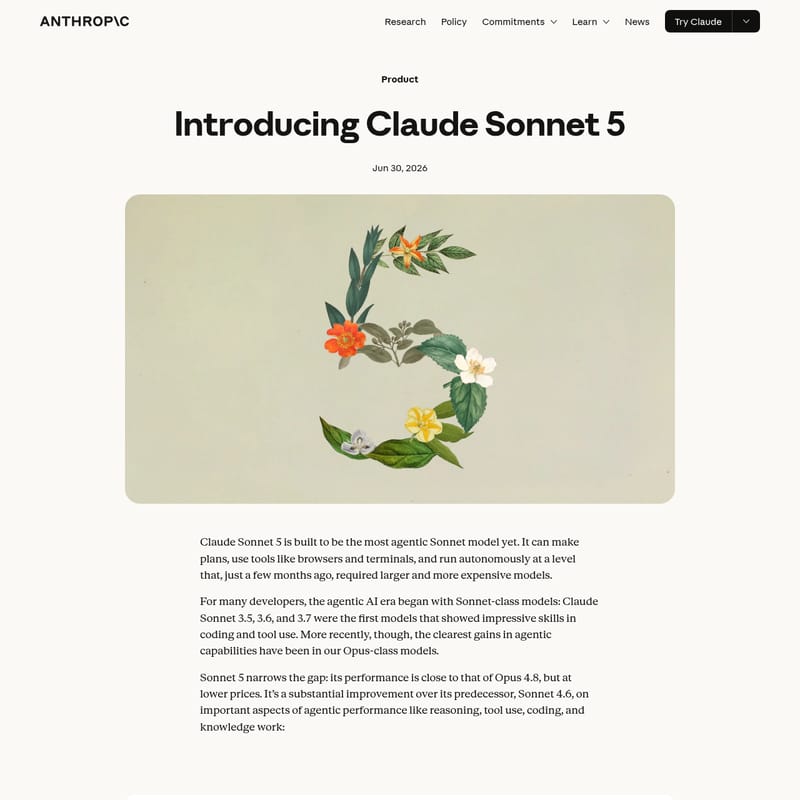
Claude Sonnet 5 Product Information
Claude Sonnet 5: The Premier Agentic AI Model for Scalable Enterprise Solutions
Launched on June 30, 2026, Claude Sonnet 5 represents a major leap forward in the evolution of artificial intelligence. As the most agentic model in the Sonnet family to date, Claude Sonnet 5 is specifically engineered to handle complex, multi-step tasks with a level of autonomy that previously required much larger and more expensive models. This article explores the capabilities, performance benchmarks, and real-world applications of this powerful new model.
What’s Claude Sonnet 5?
Claude Sonnet 5 is an advanced AI model built for the agentic era. While earlier versions like Sonnet 3.5 and 3.7 introduced impressive coding and tool-use skills, Claude Sonnet 5 narrows the performance gap between the mid-tier Sonnet class and the premium Opus class. It is designed to make autonomous plans, interact with tools such as browsers and terminals, and execute workflows without constant human intervention.
With performance levels approaching Opus 4.8, Claude Sonnet 5 offers a highly capable alternative at a significantly lower price point. It serves as a substantial upgrade over its predecessor, Sonnet 4.6, delivering better reasoning, more reliable tool use, and superior knowledge work capabilities. For enterprises and developers, Claude Sonnet 5 provides a balanced solution that maximizes performance while maintaining operational cost-efficiency.
Features of Claude Sonnet 5
1. Unmatched Agentic Capabilities
Claude Sonnet 5 is defined by its ability to act as an agent. It can browse the web, use command-line terminals, and manage multi-stage projects autonomously. Early testers have noted that Claude Sonnet 5 finishes complex tasks where previous models might have stalled, often checking its own output for errors without being prompted.
2. High-Performance Reasoning and Coding
Whether it is debugging "brownfield" code or tracing a failure to its root cause, Claude Sonnet 5 excels in technical contexts. It is a top-tier model for agentic coding, sustaining focus longer on complex tasks and following established conventions more strictly than Sonnet 4.6.
3. Cost-Effective Scaling
One of the most attractive features of Claude Sonnet 5 is its pricing. Launching with introductory rates of $2 per million input tokens and $10 per million output tokens (until August 31, 2026), it allows organizations to scale their AI operations without the heavy financial burden of larger frontier models.
4. Advanced Safety and Reliability
Safety is at the core of Claude Sonnet 5. Pre-deployment assessments indicate that the model has a lower rate of undesirable behaviors compared to Sonnet 4.6. It is more resistant to prompt injection attacks and shows reduced levels of hallucination and sycophancy. Additionally, it includes built-in cyber safeguards by default to block dangerous usage in real-time.
5. Updated Tokenizer and Rate Limits
Claude Sonnet 5 utilizes an updated tokenizer that improves how text is processed. To support high-volume usage, rate limits have been increased across all usage tiers, including Chat, Cowork, Claude Code, and the Claude Platform.
Use Case Scenarios
Software Engineering and Multi-Step Debugging
Software engineers use Claude Sonnet 5 to handle sustained coding and debugging in messy technical environments. Zimu Li, a Member of Technical Staff, highlights that the model provides a "strong execution layer for multi-step software engineering work." For instance, Neel Chotai, a Rust Engineer, reported that Claude Sonnet 5 was able to investigate a bug, write a reproducing test, and implement a fix in a single pass.
Enterprise Automation and Salesforce Management
In business operations, Claude Sonnet 5 is used to automate administrative tasks. Senior Engineer Daniel Shepard noted that the model could update Salesforce account tiers and send launch announcements end-to-end—a workflow that previously required manual intervention halfway through.
Legal Research and Analysis
For legal professionals, Claude Sonnet 5 sits on the Pareto frontier for complex tasks. Mauricio Wulfovich, a Staff ML Engineer, observes significant gains in legal research and analysis, making it an ideal choice for plaintiff-law tasks where price-to-performance is critical.
Insurance and Operations Workflows
At Pace, computer-use agents powered by Claude Sonnet 5 run insurance workflows such as submission intake and loss runs. The model takes the right action quickly, meeting the high-speed demands of real-world insurance operations.
Data Insights and Analytics
ClickHouse agents leverage Claude Sonnet 5 to explore live data and produce insights on the fly. Ryadh Dahimene, Director PM AI/ML, states that the model reasons in tighter steps, getting users to answers noticeably faster.
How to Use Claude Sonnet 5
There are several ways to integrate Claude Sonnet 5 into your workflow:
- Claude API: Developers can access the model using the identifier
claude-sonnet-5. - Claude Platform: Available for users on the native Claude Platform, as well as via AWS and Microsoft Foundry. It is also coming soon to Google Vertex.
- Claude Chat Plans: Claude Sonnet 5 is the default model for Free and Pro plans. It is also available to Max, Team, and Enterprise users.
- Claude Code: The model is integrated directly into Claude Code for agentic programming tasks.
- Effort Levels: Users can adjust the effort level (from standard to extra high) to balance cost and performance. Higher effort levels allow Claude Sonnet 5 to match Opus-class performance on specific tasks.
FAQ
What is the pricing for Claude Sonnet 5?
Through August 31, 2026, the introductory price is $2 per million input tokens and $10 per million output tokens. After this period, standard pricing will be $3 per million input tokens and $15 per million output tokens.
How does Claude Sonnet 5 compare to Opus 4.8?
Claude Sonnet 5 offers performance close to Opus 4.8 but at a lower cost. On certain benchmarks, such as agentic search (BrowseComp) and computer use (OSWorld-Verified), Claude Sonnet 5 at high-effort levels can match the capability of the Opus-class model.
Can Claude Sonnet 5 perform cybersecurity tasks?
While Claude Sonnet 5 can perform routine, non-harmful cyber tasks, it has a much lower ability to perform dangerous cybersecurity tasks (like developing software exploits) compared to Opus models. Cyber safeguards are enabled by default to ensure safe usage.
Does the new tokenizer affect my costs?
The updated tokenizer may map the same input to roughly 1.0–1.35× more tokens depending on the content. The introductory pricing is designed to keep this transition roughly cost-neutral for most users.
Is Claude Sonnet 5 available on all plans?
Yes, Claude Sonnet 5 is available across all plans, including Free, Pro, Max, Team, and Enterprise. It is currently the default model for both the Free and Pro tiers.
Note: For organizations requiring reduced guardrails for specific cybersecurity research, the Cyber Verification Program is available on the Claude Platform, AWS, and Microsoft Foundry.