
Claude Code Enables Native macOS Printing for HP Laser 1008a via SPL3 Reverse Engineering
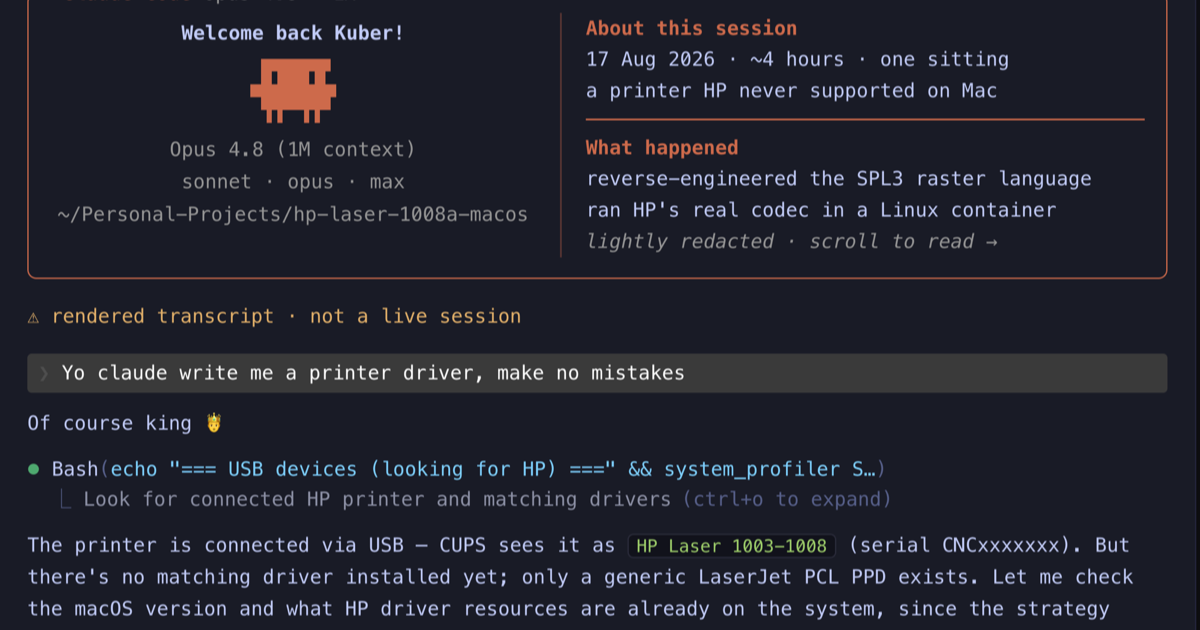
In a significant demonstration of AI-assisted hardware interfacing, a developer successfully utilized Claude Code (Opus 4.8) to enable native macOS printing for the HP Laser 1008a. This specific printer model had never received official support from HP for the Mac operating system. The breakthrough was achieved during a single four-hour session on August 17, 2026, where the AI assisted in reverse-engineering the SPL3 raster language. By running HP's proprietary codec within a Linux container, the developer bypassed traditional driver limitations. This session highlights the power of Claude Code's 1-million-token context window in solving complex, legacy compatibility issues that manufacturers have left unaddressed.
Key Takeaways
- Native Support Achieved: Claude Code Opus 4.8 successfully enabled native macOS printing for the HP Laser 1008a, a device previously unsupported by HP on the platform.
- Technical Strategy: The solution involved the complex reverse-engineering of the SPL3 raster language and the execution of HP's codec within a Linux container environment.
- Efficiency of AI: The entire project, from initial session to a working solution, was completed in approximately four hours in a single sitting.
- Advanced AI Capabilities: The use of Claude Code Opus 4.8 with a 1M context window proved critical for managing the technical depth required for driver-level reverse engineering.
In-Depth Analysis
Overcoming Manufacturer Limitations
The HP Laser 1008a has long been a point of frustration for macOS users due to the total lack of official driver support from the manufacturer. Historically, hardware compatibility is dictated by the manufacturer's willingness to maintain software across different operating systems. When a company like HP chooses not to support a specific platform, users are typically left with non-functional hardware. However, the recent session using Claude Code demonstrates a shift in this dynamic. By leveraging high-context AI, a developer was able to bridge this gap independently, creating a native printing path where none existed before. This suggests that the barrier between hardware and unsupported software environments is becoming increasingly permeable through AI-assisted development.
Technical Execution and Reverse Engineering
The core of the technical achievement lies in the reverse-engineering of the SPL3 (Samsung Printer Language version 3) raster language. Raster languages are responsible for describing the page image to the printer, and without a proper understanding of this protocol, native communication is impossible. The developer utilized Claude Code to parse and reconstruct this language. Furthermore, the implementation utilized a Linux container to run HP's actual codec. This hybrid approach—combining reverse-engineered logic with a containerized environment to execute proprietary binaries—allowed the macOS system to communicate with the printer as if it were a natively supported device. The ability to coordinate these disparate technical layers within a four-hour window underscores the efficiency of modern AI coding assistants.
The Role of Large Context AI in Hardware Interfacing
The success of this project is closely tied to the capabilities of Claude Code Opus 4.8, specifically its 1-million-token context window. Reverse-engineering a printer language and setting up containerized bridges requires the management of vast amounts of technical documentation, code snippets, and trial-and-error logs. A 1M context window allows the AI to maintain a comprehensive 'memory' of the entire session, ensuring that insights gained in the first hour regarding the SPL3 structure remain accessible and relevant in the fourth hour when configuring the Linux container. This continuity is essential for complex troubleshooting where the solution depends on a deep understanding of the entire system stack.
Industry Impact
This development has significant implications for the AI and hardware industries. First, it demonstrates that AI is moving beyond simple web and app development into the realm of low-level hardware interfacing and driver creation. This could lead to a 'right-to-repair' and 'right-to-use' renaissance, where community-driven, AI-assisted drivers extend the life of hardware that manufacturers have abandoned.
Secondly, it highlights the competitive advantage of large context windows in specialized engineering tasks. As AI models become more capable of handling entire project environments at once, the time-to-market for complex technical workarounds will continue to shrink. This session serves as a case study for how AI can empower individual developers to solve systemic compatibility issues that were previously only solvable by dedicated engineering teams at major corporations.
Frequently Asked Questions
Question: What specific printer model was fixed in this session?
Answer: The session focused on enabling native macOS printing for the HP Laser 1008a, a model that HP never officially supported on Mac.
Question: How did the developer handle the proprietary HP codec?
Answer: The developer ran the real HP codec inside a Linux container, which allowed the macOS environment to utilize the necessary proprietary logic to communicate with the printer.
Question: What is SPL3 and why was it important?
Answer: SPL3 stands for Samsung Printer Language version 3, the raster language used by the HP Laser 1008a. Reverse-engineering this language was necessary to translate macOS print commands into a format the printer could understand.
