
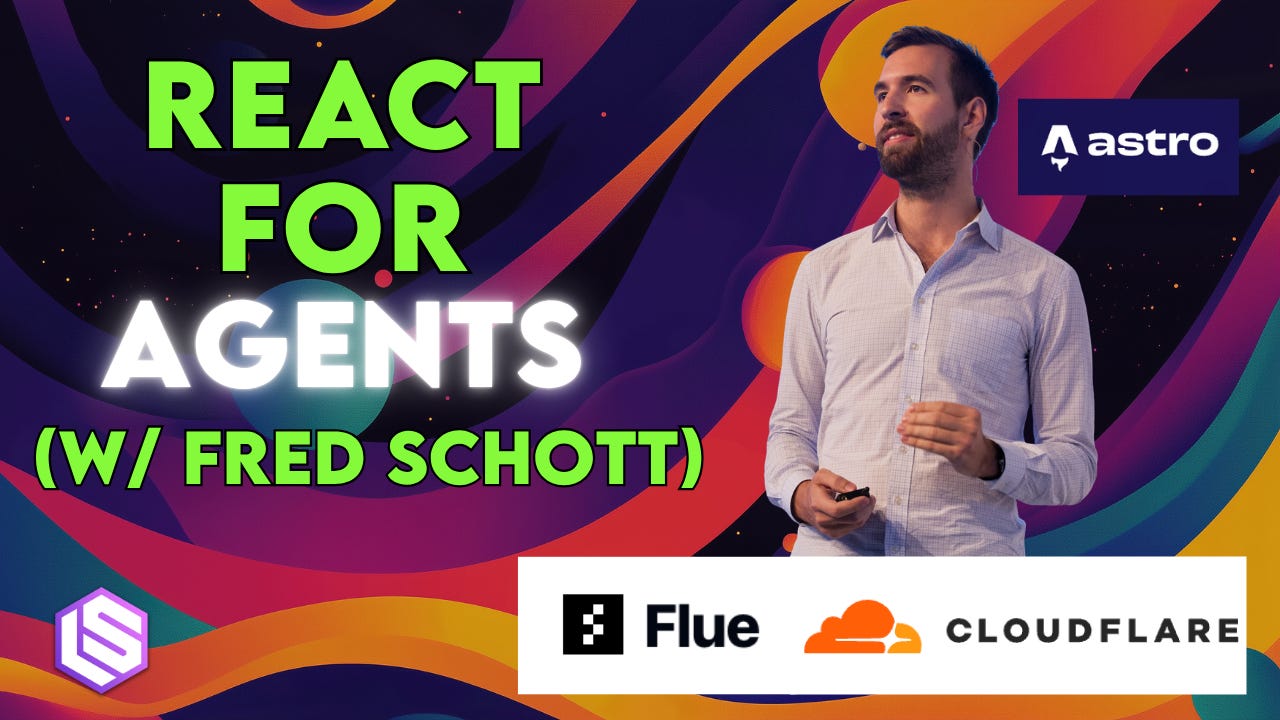
Astro Creator Fred Schott Introduces Flue 2: Bringing React-Inspired Hooks to AI Agent Meta-Harnesses
Fred Schott, the renowned creator of the Astro web framework, has officially unveiled Flue 2, a significant evolution of his "meta-harness" for AI agents. This new iteration draws direct inspiration from the React ecosystem, specifically through the implementation of "hooks" to manage agent logic and state. In a recent discussion with Latent Space, Schott detailed the architectural shift, emphasizing a core philosophy: AI agents are fundamentally defined by the harnesses they inhabit. By applying established web development paradigms like hooks to the field of AI orchestration, Flue 2 aims to provide a more structured and familiar environment for developers building complex agentic systems. This development marks a pivotal moment where the developer experience (DX) of web frameworks begins to merge with the functional requirements of autonomous AI agents.
Key Takeaways
- React-Inspired Architecture: Flue 2 incorporates "hooks," a concept popularized by the React library, to manage the internal logic and lifecycle of AI agents.
- The Harness Philosophy: Creator Fred Schott asserts that the identity and capabilities of an AI agent are primarily defined by the "harness" or environment in which it operates.
- Evolution of Flue: This second iteration of the project focuses on refining the "meta-harness" concept, moving toward more standardized developer patterns.
- Developer Experience Focus: By leveraging familiar web development concepts, Schott aims to bridge the gap between traditional software engineering and AI agent development.
In-Depth Analysis
The Integration of React Hooks into AI Orchestration
The most striking feature of Flue 2 is its adoption of "hooks," a design pattern that revolutionized state management and side effects in the React ecosystem. In the context of Flue 2, Fred Schott has adapted this concept to suit the needs of AI agents. In traditional web development, hooks allow developers to "hook into" component lifecycles and state without writing complex class-based structures. By bringing this to a "meta-harness" like Flue, Schott is proposing a world where agent behaviors—such as memory retrieval, tool usage, or state updates—can be managed with the same modularity and predictability found in modern front-end applications.
This move suggests that the complexity of managing AI agents has reached a point where simple scripting is no longer sufficient. Agents require a way to maintain context and react to changing inputs over time. By using hooks, Flue 2 provides a structured way to define these reactive behaviors. This approach not only makes the code more readable for developers coming from a JavaScript or TypeScript background but also introduces a level of composability that is often lacking in early-stage AI tooling. The use of hooks implies a shift toward a more functional and declarative style of defining what an agent does and how it responds to its environment.
The Philosophy of the Meta-Harness
Central to the development of Flue 2 is Fred Schott’s belief that "agents are defined by their harnesses." This perspective shifts the focus away from the underlying Large Language Model (LLM) as the sole identity of the agent and places it on the infrastructure that surrounds it. In Schott's view, an LLM is a raw engine, but the "harness"—the set of tools, constraints, interfaces, and protocols—is what actually shapes that engine into a functional agent.
By calling Flue a "meta-harness," Schott is positioning it as a framework for building these environments. If the harness defines the agent, then the quality of the harness directly dictates the reliability and utility of the agent. This philosophy aligns with the broader industry trend of "agentic workflows," where the orchestration layer is seen as equally important, if not more so, than the model itself. Flue 2 serves as the scaffolding that provides the necessary structure for an agent to interact with the world, manage its internal state, and execute tasks effectively. The harness acts as both the boundary and the enabler for the agent's intelligence.
Bridging Web Development and AI Engineering
Fred Schott’s background as the creator of Astro—a framework known for its focus on performance and developer experience—heavily influences the direction of Flue 2. The transition from building web frameworks to building AI agent harnesses represents a convergence of disciplines. As AI agents become more integrated into software products, the tools used to build them must meet the same standards of maintainability and scalability as the rest of the tech stack.
Flue 2 represents an attempt to standardize the "agentic" layer of software. Just as Astro simplified the process of building content-rich websites by focusing on the right abstractions, Flue 2 seeks to simplify agent development by providing a familiar set of tools. The introduction of hooks is a clear signal that the future of AI development may look a lot like the present of web development: componentized, hook-based, and highly structured. This approach could significantly lower the barrier to entry for software engineers looking to incorporate autonomous agents into their applications, as they can leverage their existing knowledge of reactive programming patterns.
Industry Impact
The release of Flue 2 and its adoption of React-like patterns could have several long-term implications for the AI industry:
- Standardization of Agent Frameworks: By using established patterns like hooks, Flue 2 may encourage other framework developers to adopt similar standardized abstractions, making it easier for developers to switch between tools.
- Shift in Focus to Orchestration: Schott’s emphasis on the "harness" reinforces the idea that the competitive advantage in AI may lie in the orchestration and environment layer rather than just the model layer.
- Improved Developer Velocity: Familiar patterns reduce the learning curve for web developers entering the AI space, potentially leading to a surge in agent-based applications and experiments.
Frequently Asked Questions
What is Flue 2?
Flue 2 is a "meta-harness" for AI agents created by Fred Schott. It is a framework designed to provide the structure, tools, and environment (the "harness") that define and enable the functionality of an AI agent.
Why did Fred Schott add hooks to Flue 2?
Inspired by the React library, Schott added hooks to Flue 2 to provide a modular and familiar way for developers to manage the state and logic of AI agents. Hooks allow for more composable and predictable agent behaviors.
What does it mean that "agents are defined by their harnesses"?
This philosophy suggests that an AI agent's capabilities and identity are not just a result of the LLM it uses, but are primarily shaped by the environment, constraints, and tools (the harness) provided to it by the developer.