
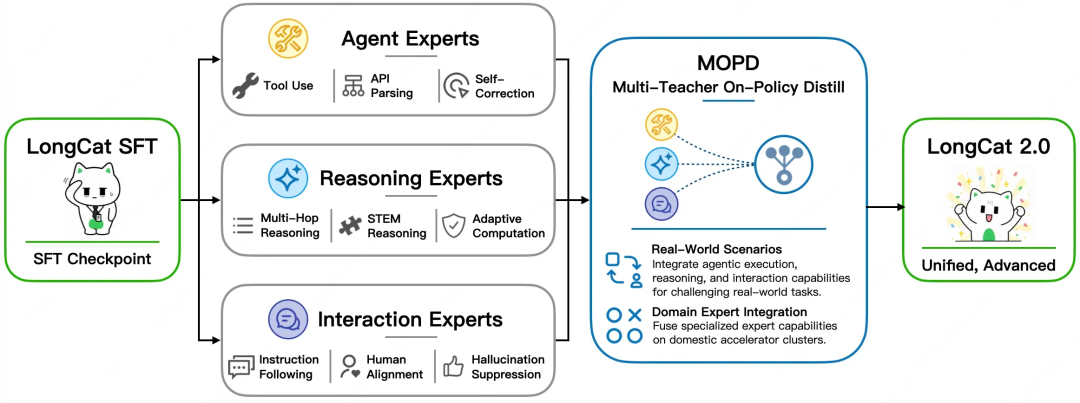
Meituan Launches LongCat-2.0: A 1.6 Trillion Parameter Model Trained on 50,000 Domestic Computing Cards
Meituan's technical team has officially unveiled LongCat-2.0, a groundbreaking large language model that marks a significant milestone in AI infrastructure. As the industry's first trillion-parameter model to complete its entire training and inference lifecycle on a domestic 50,000-card computing cluster, LongCat-2.0 features a total of 1.6 trillion parameters with a dynamic activation range. Built from scratch, the model natively supports an ultra-long context window of 1 million tokens. Its architecture is specifically optimized for "Agentic Coding," aiming to provide superior efficiency and stability in complex code understanding, generation, and execution tasks. This release highlights the growing capability of domestic hardware to support massive-scale AI development.
Key Takeaways
- Massive Scale: LongCat-2.0 features 1.6 trillion total parameters, with an average activation of approximately 48B and a dynamic range between 33B and 56B.
- Hardware Milestone: It is the first model of this scale to be trained and deployed entirely on a domestic computing cluster consisting of 50,000 cards.
- Ultra-Long Context: The model provides native support for a 1M (one million) token context window, enabling the processing of massive codebases.
- Specialized Focus: The core design objective is "Agentic Coding," focusing on the stable and efficient execution of code-related tasks.
- Original Development: LongCat-2.0 was pre-trained from scratch rather than being fine-tuned from existing open-source architectures.
In-Depth Analysis
Breaking the Hardware Barrier with Domestic Clusters
The release of LongCat-2.0 represents a pivotal moment for the AI industry, particularly regarding hardware independence. The most striking aspect of this announcement is that the model completed its full-process training and inference on a domestic computing cluster of 50,000 cards. In an era where high-end computing resources are often subject to supply chain constraints, Meituan’s ability to scale a 1.6 trillion parameter model on domestic infrastructure demonstrates a high level of software-hardware co-optimization. Managing a cluster of 50,000 cards requires sophisticated distributed training techniques to maintain stability and efficiency, especially when dealing with the complexities of a trillion-parameter architecture. This achievement proves that domestic clusters are now capable of supporting the most demanding "from-scratch" pre-training workloads in the industry.
Architectural Efficiency and the Trillion-Parameter Threshold
LongCat-2.0 utilizes a sophisticated parameter structure to balance raw power with computational efficiency. While the total parameter count reaches a staggering 1.6 trillion (1.6T), the model employs a dynamic activation strategy. On average, only about 48 billion parameters are activated during a given task, with a dynamic range fluctuating between 33B and 56B. This approach suggests a highly optimized architecture—likely utilizing Mixture-of-Experts (MoE) principles—that allows the model to maintain the knowledge capacity of a trillion-parameter system while operating with the speed and lower latency of a much smaller model. By pre-training this architecture from scratch, Meituan has ensured that the model's foundational weights are natively aligned with its specific performance goals, rather than inheriting the biases or limitations of existing frameworks.
Native 1M Context and the Rise of Agentic Coding
A defining feature of LongCat-2.0 is its native support for a 1 million (1M) token context window. In the context of software development, this capability is transformative. Traditional models often struggle with large-scale repositories, requiring developers to shard code or use complex retrieval-augmented generation (RAG) systems. LongCat-2.0’s 1M context allows it to "read" and understand entire projects simultaneously. This is the foundation for what Meituan terms "Agentic Coding." Unlike standard code completion, Agentic Coding implies a model that can act as an autonomous or semi-autonomous agent—understanding complex requirements, generating multi-file solutions, and executing code with a high degree of stability. The focus here is not just on writing snippets of code, but on the holistic understanding and execution of tasks within a real-world development environment.
Industry Impact
The launch of LongCat-2.0 has profound implications for both the AI and software engineering industries. First, it sets a new benchmark for domestic computing capabilities, proving that massive-scale AI development is viable without total reliance on restricted global hardware chains. This could accelerate the adoption of domestic AI infrastructure across other sectors.
Second, the focus on "Agentic Coding" signals a shift in the AI application layer. As models move from simple assistants to agents capable of full-process code execution, the productivity of software development could see an exponential increase. Meituan’s emphasis on stability and efficiency in these tasks suggests that the industry is moving past the "experimental" phase of AI coding and into a phase of reliable, production-grade automation. Finally, the native 1M context support pushes the boundaries of how LLMs handle long-form data, likely prompting competitors to prioritize context window expansion in their upcoming releases.
Frequently Asked Questions
Question: What makes LongCat-2.0 different from other trillion-parameter models?
LongCat-2.0 is unique because it is the first model of its size to be trained and inferred entirely on a domestic 50,000-card cluster. Additionally, it features a dynamic activation range (33B-56B) despite its 1.6T total parameters, and it is specifically optimized for "Agentic Coding" with a native 1M context window.
Question: What is "Agentic Coding" in the context of LongCat-2.0?
Agentic Coding refers to the model's ability to go beyond simple code generation. It is designed to function as an agent that can understand, generate, and execute code within complex, real-world tasks. The architecture focuses on the stability and efficiency required for these autonomous coding operations.
Question: How does the 1M context window benefit developers?
A 1M context window allows the model to process and remember up to a million tokens of information at once. For developers, this means the model can analyze entire codebases, extensive documentation, and complex project structures simultaneously without losing track of details, which is essential for large-scale software engineering.

