Meituan LongCat Team Open-Sources WBench: The First Systematic Multi-Round Evaluation Benchmark for Interactive Video World Models
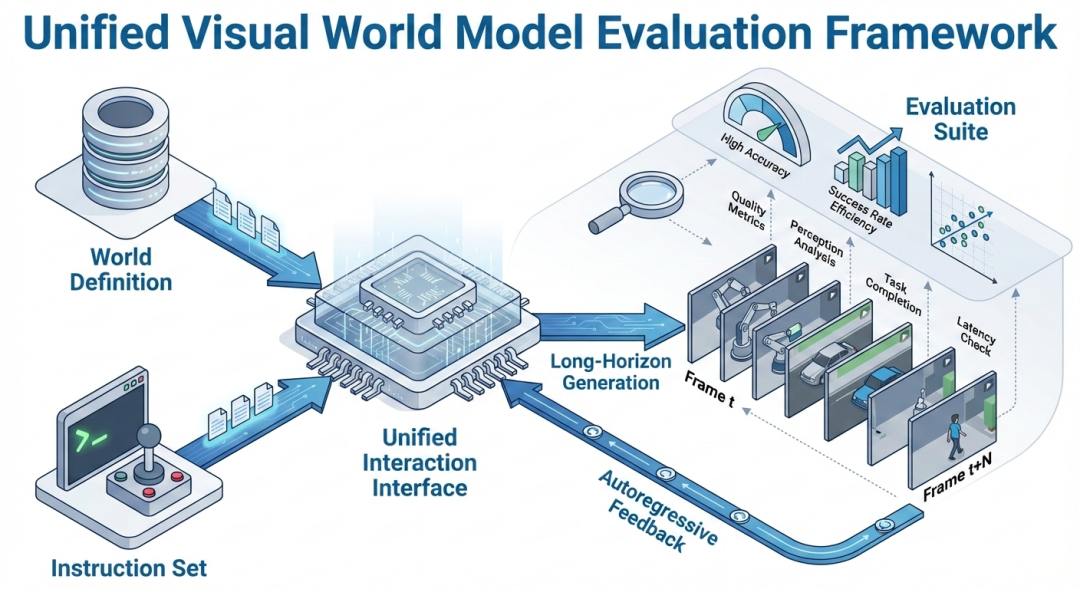
The Meituan LongCat team has officially introduced and open-sourced WBench, a pioneering systematic multi-round evaluation benchmark designed specifically for interactive video world models. Described as a "CT scanner" for AI, WBench is engineered to provide a precise diagnosis of the current limitations within world models as they transition from passive video observation to active, multi-round interaction. By establishing a structured framework for assessment, the benchmark aims to identify exactly where models struggle to maintain consistency and logic during interactive sequences. This release marks a significant milestone in AI research, offering a standardized tool to measure the boundaries of world models in diverse scenarios ranging from lunar environments to futuristic urban settings.
Key Takeaways
- Introduction of WBench: Meituan's LongCat team has developed and open-sourced the first systematic multi-round evaluation benchmark for interactive video world models.
- Diagnostic Capabilities: The benchmark functions as a "CT scanner," allowing researchers to pinpoint specific technical bottlenecks in model performance.
- Focus on Interaction: WBench specifically targets the transition from "passive viewing" to "active interaction," a critical frontier in world model development.
- Multi-Round Assessment: Unlike single-turn evaluations, WBench emphasizes the complexity of multi-round sequences to test the sustained logic of AI environments.
- Broad Scope: The benchmark explores the boundaries of world models across varied conceptual landscapes, from "moonwalks" to "cyber cities."
In-Depth Analysis
The "CT Scanner" for World Models
The introduction of WBench by the Meituan LongCat team represents a shift toward more rigorous diagnostic tools in the field of artificial intelligence. By positioning WBench as a "CT scanner," the developers highlight a move away from general performance metrics toward a more granular, internal examination of how world models function. Current world models often excel at generating visually coherent video content in a passive capacity—where the model simply predicts the next frame based on a prompt. However, WBench is designed to look deeper, identifying the exact points of failure when these models are required to sustain a coherent environment over multiple rounds of interaction. This diagnostic approach is essential for understanding the underlying architecture's ability to maintain spatial and temporal consistency under pressure.
Bridging the Gap: From Passive Viewing to Active Interaction
A central challenge identified by the LongCat team is the boundary between "passive viewing" and "active interaction." In a passive context, a world model acts as a generator; in an active context, it must act as a simulator that responds logically to external inputs. WBench provides the first systematic framework to measure this transition. By evaluating how a model handles multi-round interactions, the benchmark tests whether the AI can maintain the "rules" of its world—such as physics, object permanence, and environmental logic—when a user or system interacts with it. The benchmark's ability to test scenarios as diverse as a "moonwalk" or a "cyber city" suggests that it is designed to push the limits of how these models generalize across different physical and aesthetic laws.
Defining the Boundaries of World Models
The title of the research, "From Moonwalk to Cyber City," encapsulates the broad spectrum of environments that WBench is capable of evaluating. This range indicates that the benchmark is not limited to realistic or mundane scenarios but extends into highly stylized or low-gravity environments where traditional data might be sparse. By testing the "boundaries" of these world models, WBench helps researchers understand if a model truly understands the causal relationships within a world or if it is merely replicating patterns. The systematic nature of this multi-round evaluation ensures that any degradation in the world's logic over time is captured, providing a clear map of where current technology "gets stuck."
Industry Impact
The release of WBench is poised to have a significant impact on the AI industry by providing a much-needed standard for world model evaluation. As the industry moves toward more sophisticated interactive AI, such as autonomous agents and advanced simulators, the lack of a systematic benchmark has been a major hurdle. By open-sourcing WBench, Meituan is fostering a collaborative environment where researchers can compare results and iterate on model architectures with greater precision. This benchmark will likely accelerate the development of more robust world models that can be used in gaming, robotics, and virtual reality, where multi-round interaction and environmental consistency are paramount. Furthermore, the focus on "active interaction" sets a new bar for what constitutes a successful world model, moving the goalposts from mere visual fidelity to functional, interactive intelligence.
Frequently Asked Questions
Question: What makes WBench different from existing video evaluation benchmarks?
WBench is the first benchmark to focus specifically on "multi-round" and "interactive" evaluation for video world models. While traditional benchmarks often measure the quality of a single generated video clip (passive viewing), WBench acts as a diagnostic tool to see how well a model maintains its world logic over multiple rounds of active interaction.
Question: Why did the Meituan LongCat team open-source WBench?
By open-sourcing WBench, the Meituan LongCat team allows the broader AI research community to use the tool to identify bottlenecks in their own world models. This transparency helps standardize how "interactive world models" are measured and encourages collective progress in moving AI from passive observation to active agency.
Question: What does the "CT scanner" metaphor imply for AI development?
The metaphor implies that WBench provides a non-invasive but deep look into the internal consistency and logical failures of a model. Just as a medical CT scanner finds hidden issues within a body, WBench identifies the specific "stuck points" in a world model's interactive capabilities that are not visible through simple observation.