
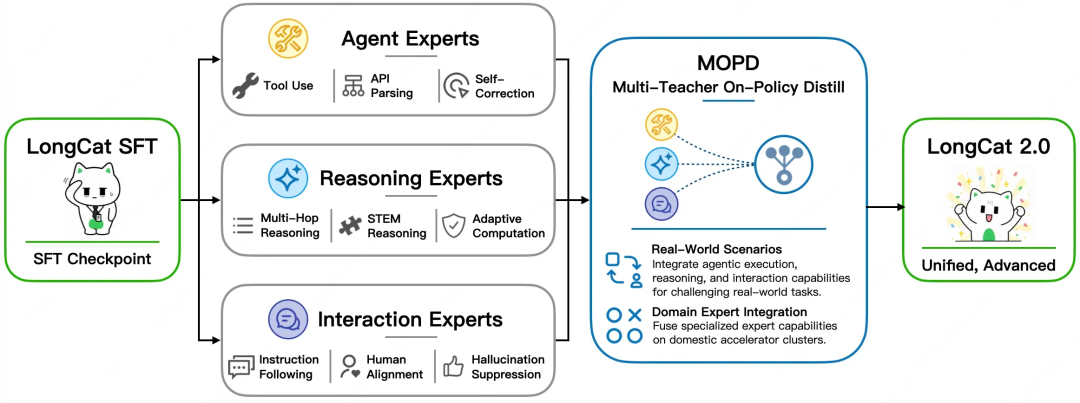
Meituan Unveils LongCat-2.0: A 1.6 Trillion Parameter Model Optimized for Agentic Coding on Domestic Clusters
Meituan's technical team has officially announced the release of LongCat-2.0, a pioneering large-scale model featuring 1.6 trillion total parameters. This model distinguishes itself as the industry's first trillion-parameter model to complete its entire training and inference lifecycle on a domestic computing cluster consisting of 50,000 cards. LongCat-2.0 was pre-trained from scratch and natively supports a 1-million-token long context window. With an architecture designed for efficiency, it maintains an average of 48 billion active parameters within a dynamic range of 33B to 56B. The model is specifically engineered to enhance the stability and performance of 'Agentic Coding' tasks, focusing on the comprehensive understanding, generation, and execution of code in real-world scenarios.
Key Takeaways
- Massive Scale on Domestic Hardware: LongCat-2.0 is the first 1.6T parameter model to achieve full-process training and inference on a 50,000-card domestic computing cluster.
- Dynamic MoE Architecture: While the total parameters reach 1.6 trillion, the model utilizes a dynamic activation strategy with an average of 48B active parameters (ranging from 33B to 56B) for high efficiency.
- Native Long Context Support: The model features native support for a 1M (one million) token context window, allowing for the processing of extensive codebases and complex documents.
- Focus on Agentic Coding: The core design objective is to provide a stable and efficient platform for autonomous coding agents to understand, generate, and execute code.
- Pre-trained from Scratch: Unlike models that fine-tune existing weights, LongCat-2.0 underwent a complete pre-training process to optimize its foundational capabilities.
In-Depth Analysis
Breakthrough in Domestic Computing Infrastructure
The release of LongCat-2.0 marks a significant milestone in the utilization of domestic computing power for ultra-large-scale AI development. By successfully executing the full lifecycle of a trillion-parameter model—from initial pre-training to final inference—on a cluster of 50,000 domestic cards, Meituan has demonstrated the viability of large-scale AI production independent of traditional global hardware chains. This achievement highlights the maturity of domestic software and hardware stacks in handling the immense communication and synchronization overhead required for a 1.6T parameter architecture. The "full-process" nature of this deployment suggests that the infrastructure is capable of supporting not just the training phase, but also the high-throughput demands of real-world inference at scale.
Architectural Innovation: Balancing Scale and Efficiency
LongCat-2.0 employs a sophisticated architectural design that balances the power of a trillion-parameter model with the operational efficiency required for practical use. With a total parameter count of 1.6T, the model utilizes a dynamic activation mechanism. On average, only 48B parameters are active during any given computation, with the active range fluctuating between 33B and 56B. This approach allows the model to maintain the representational capacity of a massive system while keeping the computational cost and latency closer to that of much smaller models. This dynamic range is crucial for maintaining stability during complex tasks, ensuring that the model can allocate more resources to difficult problems while remaining efficient during simpler operations.
Native 1M Context and the Evolution of Agentic Coding
A standout feature of LongCat-2.0 is its native support for a 1-million-token context window. In the realm of software engineering, this capability is transformative. It allows the model to ingest entire repositories, extensive documentation, and long execution logs simultaneously. Meituan has explicitly oriented this model toward "Agentic Coding," a paradigm where the AI does not merely suggest snippets of code but acts as an agent capable of understanding the broader project structure, generating functional code, and overseeing its execution. The focus on stability and efficiency in these tasks suggests that LongCat-2.0 is designed to minimize the errors and hallucinations often associated with long-context processing, providing a reliable foundation for automated development workflows.
Industry Impact
The introduction of LongCat-2.0 signals a shift in the AI industry toward specialized, high-capacity models that are deeply integrated with specific hardware environments. By proving that a 1.6T parameter model can be trained and run on a 50,000-card domestic cluster, Meituan has set a new benchmark for infrastructure self-sufficiency. Furthermore, the emphasis on Agentic Coding indicates a move away from general-purpose assistants toward specialized agents that can handle end-to-end professional tasks. The native 1M context support also pushes the boundaries of how AI interacts with large-scale data, potentially setting a new standard for long-form content processing in the industry.
Frequently Asked Questions
Question: What makes LongCat-2.0 different from other trillion-parameter models?
LongCat-2.0 is unique because it is the first model of this scale (1.6T parameters) to be trained and deployed entirely on a 50,000-card domestic computing cluster. Additionally, it features a dynamic activation range (33B-56B) and native 1M context support specifically optimized for coding tasks.
Question: What is "Agentic Coding" and why is it the focus of this model?
Agentic Coding refers to the ability of an AI to act as an autonomous agent in the software development process. This includes not just writing code, but understanding complex project architectures and executing code. LongCat-2.0 is designed to make these processes more stable and efficient for real-world applications.
Question: How does the 1M context window benefit developers?
A 1M context window allows the model to "read" and remember up to a million tokens of information at once. For developers, this means the model can analyze entire codebases or very long technical manuals without losing track of the earlier parts of the file, leading to more accurate and context-aware code generation.
