Meituan Launches LongCat-2.0: A 1.6 Trillion Parameter Model Trained on 50,000-Card Domestic Cluster
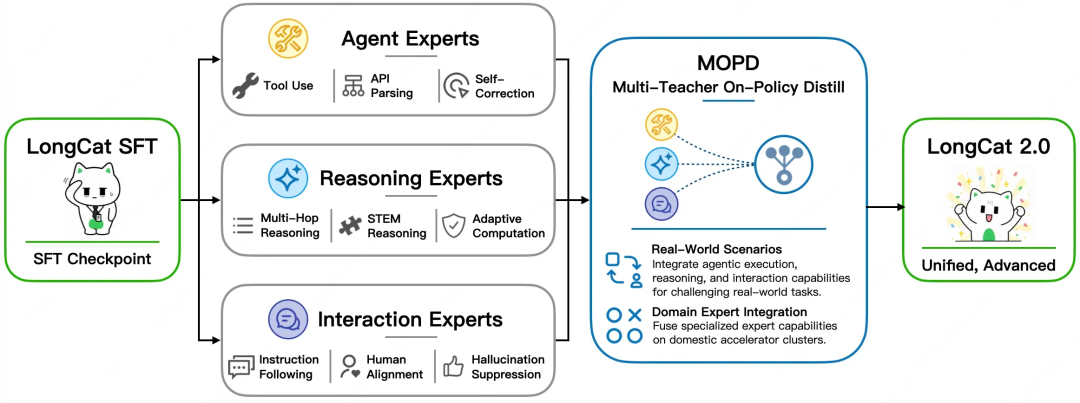
Meituan's technology team has officially announced the release of LongCat-2.0, a landmark trillion-parameter large language model. It represents a significant milestone as the industry's first model of this scale to complete its full training and inference lifecycle on a domestic computing cluster featuring 50,000 cards. LongCat-2.0 boasts a total of 1.6 trillion parameters with an average activation of 48 billion, utilizing a dynamic range of 33B to 56B. Pre-trained from scratch, the model natively supports a 1-million-token long context window. Its architecture is specifically engineered to optimize performance in Agentic Coding tasks, focusing on the efficient and stable understanding, generation, and execution of code in real-world scenarios.
Key Takeaways
- Massive Scale: LongCat-2.0 features a total of 1.6 trillion parameters, making it one of the largest models in the industry.
- Infrastructure Milestone: It is the first trillion-parameter model to undergo full-process training and inference on a domestic computing cluster of 50,000 cards.
- Dynamic Efficiency: While the total parameters reach 1.6T, the model maintains efficiency with an average activation of 48B parameters and a dynamic range between 33B and 56B.
- Long Context Support: The model natively supports a 1M (one million) token context window, facilitating the processing of massive codebases.
- Specialized Application: The architecture is purpose-built for Agentic Coding, emphasizing stability in code comprehension and execution.
In-Depth Analysis
Breakthrough in Domestic Computing Infrastructure
The release of LongCat-2.0 by Meituan marks a pivotal moment for domestic AI infrastructure. The model was trained and deployed on a massive cluster consisting of 50,000 domestic computing cards. This achievement demonstrates the capability of domestic hardware to support the entire lifecycle—from initial pre-training to final inference—of a model exceeding the trillion-parameter threshold. By successfully managing the complexities of a 50,000-card cluster, Meituan has proven that large-scale AI development can be sustained on localized hardware, reducing reliance on external silicon ecosystems. This full-process integration ensures that the model's performance is tightly coupled with the underlying hardware architecture, potentially leading to higher stability and optimized resource utilization.
Architectural Innovation and Parameter Dynamics
LongCat-2.0 utilizes a sophisticated parameter structure to balance raw power with computational efficiency. Although the total parameter count is a staggering 1.6 trillion (1.6T), the model does not activate all parameters simultaneously. Instead, it operates with an average activation of approximately 48 billion (48B) parameters. The dynamic range of activation fluctuates between 33B and 56B, suggesting a Mixture-of-Experts (MoE) or a similar conditional computation approach. This design allows the model to leverage the knowledge capacity of a 1.6T parameter system while maintaining the inference speed and cost-effectiveness of a much smaller model. Furthermore, the model was pre-trained from scratch, ensuring that its foundational knowledge and internal representations are optimized specifically for its intended tasks rather than being fine-tuned from a generic base.
Native 1M Context and Agentic Coding Focus
A standout feature of LongCat-2.0 is its native support for a 1-million-token (1M) context window. In the realm of software development, this capability is transformative. It allows the model to ingest and analyze entire repositories, complex documentation, and long execution traces simultaneously. The core objective of this architecture is to excel in "Agentic Coding" tasks. Unlike traditional code completion, Agentic Coding requires the model to act as an autonomous or semi-autonomous agent capable of understanding high-level requirements, generating complex logic, and overseeing the execution process. By focusing on efficiency and stability in these specific tasks, LongCat-2.0 aims to provide a more reliable tool for professional developers, ensuring that code generation is not just fast, but contextually accurate and executable within real-world environments.
Industry Impact
The introduction of LongCat-2.0 has significant implications for the global AI landscape, particularly in the specialized field of AI-assisted software engineering. By scaling to 1.6 trillion parameters on a domestic cluster, Meituan has set a new benchmark for what is possible with localized computing resources. This move likely signals a shift toward more specialized, high-capacity models that target specific high-value industries like software development. The focus on Agentic Coding suggests that the industry is moving beyond simple chat interfaces toward integrated AI agents that can handle end-to-end technical workflows. Furthermore, the successful deployment of a 1M context window at this parameter scale challenges existing limits on how much information an AI can "remember" and process at once, potentially leading to a new generation of AI tools that can manage massive, interconnected data systems with unprecedented ease.
Frequently Asked Questions
Question: What makes LongCat-2.0 different from other trillion-parameter models?
LongCat-2.0 is unique because it is the first model of its size to be trained and run entirely on a 50,000-card domestic computing cluster. Additionally, it features a dynamic activation system where only 33B to 56B parameters are active at any given time, despite having a 1.6T total parameter count, and it natively supports a 1M token context window.
Question: What is "Agentic Coding" and how does LongCat-2.0 support it?
Agentic Coding refers to AI tasks where the model acts as an agent to understand, generate, and execute code autonomously. LongCat-2.0 supports this through its specialized architecture and 1M context window, which allow it to maintain stability and efficiency when handling large-scale coding projects and complex execution logic.
Question: Was LongCat-2.0 built on top of an existing model?
No, LongCat-2.0 was pre-trained from scratch. This means its entire knowledge base and architectural weights were developed specifically for this model, rather than being adapted from a previous version or a different base model.