Meituan Launches LongCat-2.0: A Trillion-Parameter Model Trained on a 50,000-Card Domestic Computing Cluster
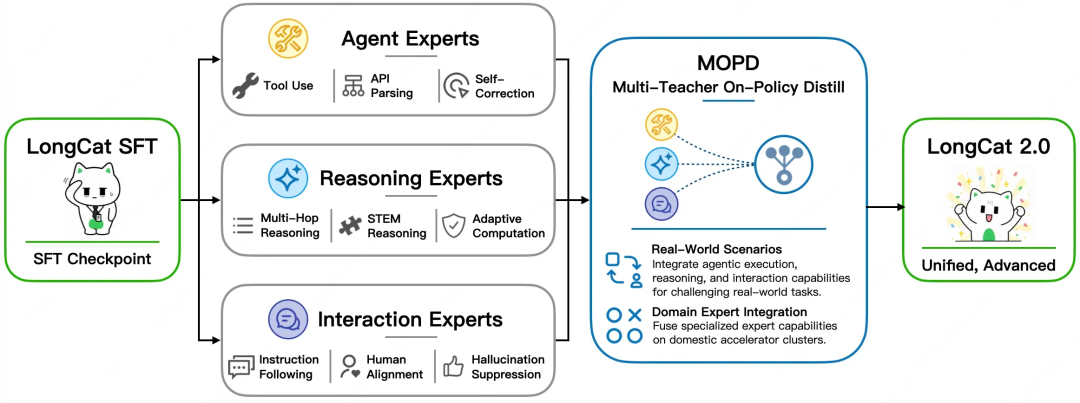
Meituan's technology team has officially unveiled LongCat-2.0, a groundbreaking trillion-parameter model that marks a significant milestone in AI development. As the industry's first model of this scale to complete its entire training and inference lifecycle on a domestic computing cluster of 50,000 cards, LongCat-2.0 features 1.6 trillion total parameters with a dynamic activation range. Pre-trained from scratch, the model natively supports a 1M long context window. Its architecture is specifically engineered to excel in Agentic Coding tasks, focusing on the efficient and stable understanding, generation, and execution of code. This release highlights the growing capability of domestic infrastructure to support massive-scale AI workloads and specialized coding applications.
Key Takeaways
- Massive Scale: LongCat-2.0 features 1.6 trillion total parameters, with an average activation of approximately 48B and a dynamic range between 33B and 56B.
- Infrastructure Milestone: It is the first trillion-parameter model to complete the full process of training and inference on a domestic computing cluster consisting of 50,000 cards.
- Extended Context: The model natively supports a 1M (one million) token long context window, pre-trained from the ground up.
- Specialized Focus: The architecture is optimized for "Agentic Coding," aiming for high efficiency and stability in code comprehension, generation, and execution.
In-Depth Analysis
Breakthrough in Domestic Computing Infrastructure
The release of LongCat-2.0 by Meituan represents a pivotal moment for the AI industry, particularly regarding hardware self-reliance. The model was trained and deployed on a domestic computing cluster featuring 50,000 cards. This achievement demonstrates that domestic hardware stacks are now capable of handling the extreme computational demands of trillion-parameter models (1.6T).
Completing the "full-flow" (training and inference) on such a massive cluster suggests a high level of optimization between the software framework and the underlying hardware. For a model of this magnitude, maintaining stability across 50,000 cards during a from-scratch pre-training phase is a significant engineering feat. It indicates that the bottlenecks typically associated with large-scale distributed training—such as interconnect bandwidth, memory management, and fault tolerance—have been addressed within this domestic ecosystem.
Architectural Innovation: 1.6T Parameters and Dynamic Activation
LongCat-2.0 utilizes a sophisticated architecture that balances massive capacity with computational efficiency. While the total parameter count reaches 1.6 trillion, the model employs a dynamic activation strategy. On average, only about 48B parameters are activated during a given task, with the dynamic range shifting between 33B and 56B depending on the input requirements.
This approach allows the model to maintain the vast knowledge base and reasoning capabilities of a trillion-parameter system while keeping the inference costs and latency closer to that of much smaller models. By pre-training this structure from scratch, Meituan ensures that the model's internal representations are optimized for this specific dynamic activation pattern, rather than being adapted from a dense architecture. This foundational training is crucial for the stability and performance observed in complex tasks.
Native 1M Context and the Shift to Agentic Coding
One of the most standout features of LongCat-2.0 is its native support for a 1M long context window. In the realm of software engineering, a million-token context allows the model to ingest entire codebases, extensive documentation, and complex execution logs simultaneously. This is a prerequisite for what Meituan terms "Agentic Coding."
Unlike traditional coding assistants that focus on line-by-line completion, Agentic Coding implies a more autonomous and holistic approach. The model is designed not just to write code, but to understand the broader context of a project, generate functional modules, and even oversee execution. The architecture's focus on efficiency and stability in these tasks suggests that LongCat-2.0 is built to act as a reliable agent within a developer's workflow, handling long-range dependencies in code that shorter-context models would inevitably lose track of.
Industry Impact
The launch of LongCat-2.0 has profound implications for both the AI and software development industries. Firstly, it proves the viability of trillion-parameter model development using entirely domestic computing resources at a scale of 50,000 cards. This reduces dependency on external high-end chipsets and sets a benchmark for other domestic tech giants.
Secondly, the focus on Agentic Coding signals a shift in the AI application layer. By optimizing for the full lifecycle of code—understanding, generation, and execution—Meituan is pushing the boundaries of how AI can be integrated into professional production environments. The combination of a 1.6T parameter brain and a 1M token memory window positions LongCat-2.0 as a powerful tool for automating complex software engineering tasks, potentially increasing developer productivity across the industry.
Frequently Asked Questions
Question: What are the specific parameter counts for LongCat-2.0?
LongCat-2.0 has a total of 1.6 trillion (1.6T) parameters. However, it uses a dynamic activation mechanism where the average active parameters are approximately 48B, ranging from 33B to 56B depending on the specific task.
Question: What makes the training of LongCat-2.0 unique in the industry?
It is the first trillion-parameter model to be trained and run for inference entirely on a domestic computing cluster of 50,000 cards. Furthermore, it was pre-trained from scratch rather than being fine-tuned from an existing model, and it natively supports a 1M token context window.
Question: What is "Agentic Coding" in the context of this model?
Agentic Coding refers to the model's ability to handle the full spectrum of programming tasks—understanding, generating, and executing code—with high stability and efficiency. It is designed to function more like an autonomous agent within a coding environment rather than a simple text predictor.