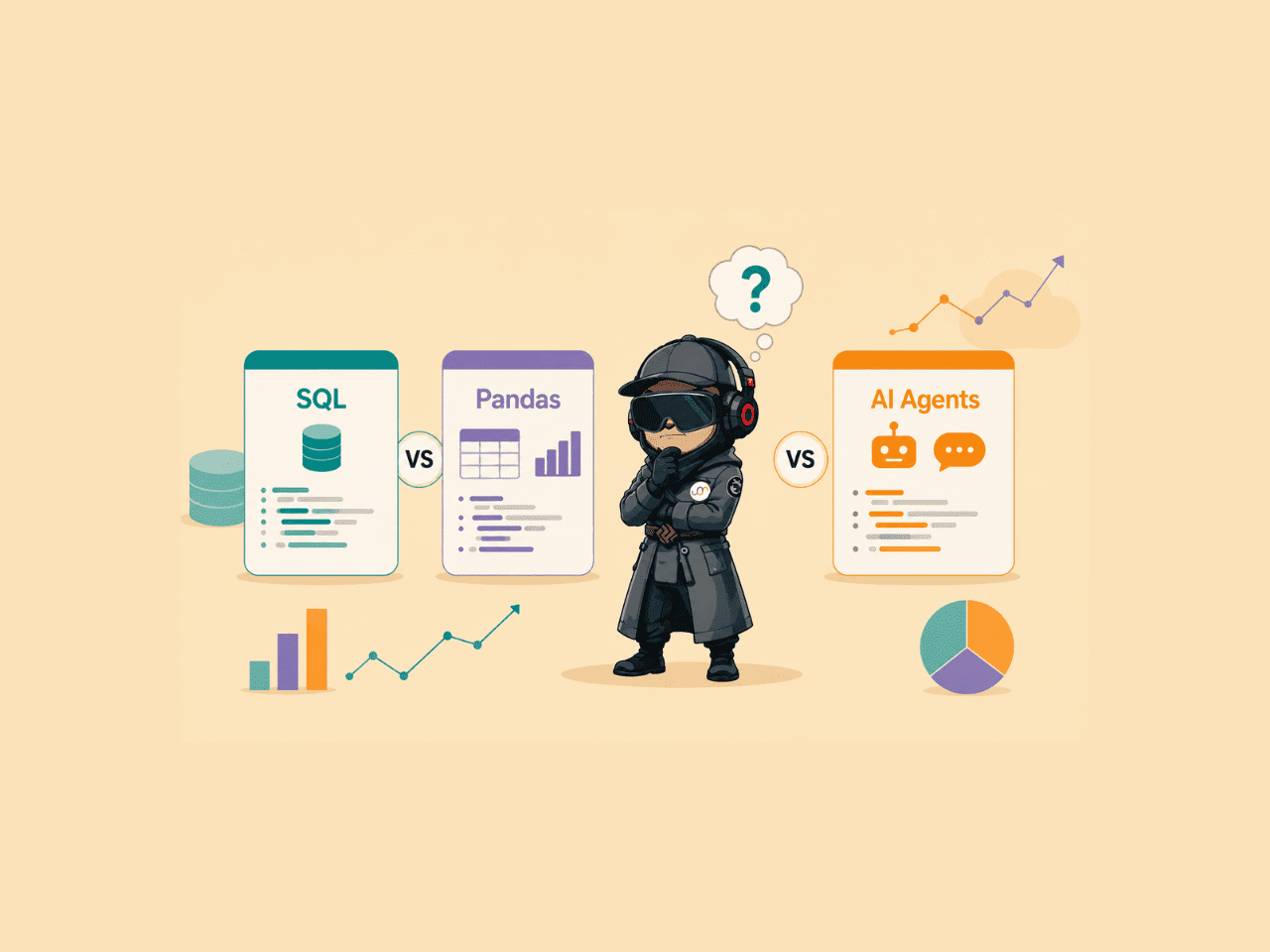
SQL vs Pandas vs AI Agents: Evaluating the Best Tools for Modern Data Analytics
A recent study published on KDnuggets by Nate Rosidi provides a comprehensive comparison between three primary approaches to data analytics: SQL, Pandas, and AI Agents. The analysis subjects these three tools to three distinct analytics problems, evaluating their performance across eight specific dimensions. Unlike theoretical comparisons, this study utilizes real-world execution times and actual prompts used for AI agents to determine which tool offers the most efficiency and accuracy. By benchmarking traditional query languages against modern data manipulation libraries and emerging autonomous AI agents, the research offers critical insights into the evolving landscape of data science and the practical utility of agentic workflows in solving complex analytical tasks.
Key Takeaways
- Comprehensive Benchmarking: The study compares three distinct technological approaches—SQL, Pandas, and AI Agents—to solve identical analytics problems.
- Multi-Dimensional Evaluation: Each tool is measured across eight different dimensions to provide a holistic view of its performance and usability.
- Real-World Metrics: The analysis relies on actual execution times and real-world agent prompts rather than theoretical or simulated data.
- Problem-Solving Scope: The evaluation is based on three specific analytics problems designed to test the versatility and efficiency of each tool.
In-Depth Analysis
The Methodology: Three Problems and Eight Dimensions
The core of this analysis lies in its structured methodology. By applying SQL, Pandas, and AI Agents to the same three analytics problems, the study creates a controlled environment to observe how different logic structures handle data tasks. SQL represents the traditional, declarative approach to data retrieval and manipulation, while Pandas represents the imperative, programmatic approach common in Python-based data science workflows. AI Agents represent the newest frontier, utilizing large language models (LLMs) to interpret natural language prompts and execute code autonomously.
The use of eight dimensions for measurement ensures that the comparison goes beyond simple speed. While execution time is a critical metric included in the study, the multi-dimensional approach suggests an evaluation of factors such as code complexity, ease of use, maintainability, and the accuracy of the output. By using real execution times, the study provides a practical benchmark that reflects the actual experience of a data professional working in a production environment.
Tool Comparison: SQL, Pandas, and AI Agents
The study highlights the unique characteristics of each tool within the context of problem-solving. SQL is often favored for its efficiency in handling large datasets directly within databases, whereas Pandas is known for its flexibility in data transformation and integration with machine learning pipelines. The inclusion of AI Agents in this comparison is particularly significant, as it tests whether autonomous systems can match the precision of hand-coded solutions.
A critical component of the AI Agent evaluation is the use of real agent prompts. This allows for an assessment of how sensitive these agents are to instruction and how effectively they can translate a high-level analytics goal into a successful execution. By comparing the prompts to the manual code required for SQL and Pandas, the study sheds light on the potential for AI to reduce the technical barrier to complex data analysis.
Performance and Prompt Engineering
By focusing on real execution times, the research addresses one of the primary concerns in the industry: the overhead of AI. While AI Agents might offer faster development times through natural language interfaces, their execution efficiency compared to optimized SQL queries or Pandas operations is a key point of interest. The study’s reliance on actual data points provides a clear picture of where AI Agents currently stand in the hierarchy of data tools.
Furthermore, the documentation of real agent prompts serves as a valuable resource for understanding the current state of prompt engineering in analytics. It demonstrates the level of specificity required to guide an agent toward a correct solution and how that effort compares to the traditional task of writing and debugging code in SQL or Python.
Industry Impact
The comparison between SQL, Pandas, and AI Agents reflects a broader shift in the data science industry toward automation and high-level abstraction. As AI Agents become more integrated into data workflows, understanding their strengths and weaknesses relative to established tools like SQL and Pandas is essential for organizations looking to optimize their tech stacks.
This study suggests that the choice of tool may depend heavily on the specific dimension being prioritized—whether it be speed of execution, speed of development, or the complexity of the problem. For the AI industry, the results provide a roadmap for where AI Agents need to improve to become competitive with traditional, highly optimized data manipulation methods. It also highlights the growing importance of agentic workflows as a legitimate alternative to manual coding for analytical problem-solving.
Frequently Asked Questions
Question: What are the three tools compared in the study?
The study compares SQL (a standard language for database management), Pandas (a popular Python library for data manipulation), and AI Agents (autonomous systems driven by large language models).
Question: How was the performance of these tools measured?
Performance was measured across eight dimensions using three specific analytics problems. The study utilized real execution times and actual prompts used for the AI agents to ensure the results reflect real-world usage.
Question: Why is the inclusion of AI Agents significant in this comparison?
Including AI Agents is significant because it benchmarks emerging autonomous technology against established industry standards like SQL and Pandas, providing insight into whether AI can effectively replace or augment traditional manual coding in data analytics.