Meituan LongCat Team Open-Sources WBench: The First Systematic Multi-Round Evaluation Benchmark for Interactive Video World Models
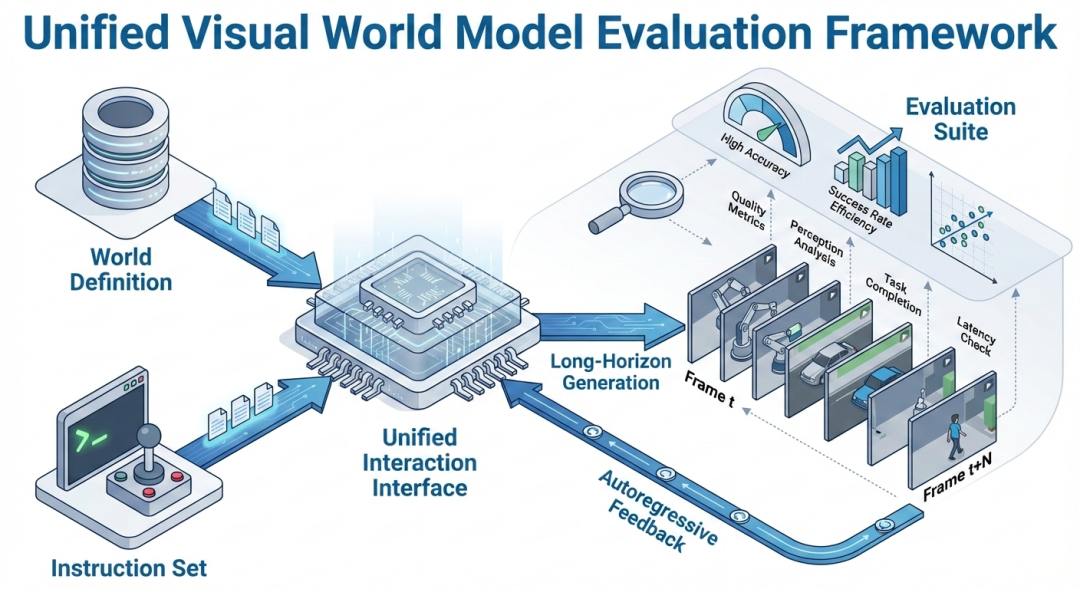
The Meituan LongCat team has officially released and open-sourced WBench, a groundbreaking evaluation framework designed to assess interactive video world models. As the first systematic multi-round benchmark of its kind, WBench functions as a diagnostic "CT scanner," providing precise insights into the performance bottlenecks of current AI models. The tool specifically targets the transition from "passive viewing" to "active interaction," allowing researchers to identify exactly where models fail when navigating complex environments—from lunar landscapes to futuristic cyber cities. By providing a rigorous structure for multi-round testing, WBench aims to define the current boundaries of world models and facilitate the development of more responsive and consistent interactive AI systems.
Key Takeaways
- Pioneering Benchmark: WBench is the first systematic, multi-round evaluation benchmark specifically designed for interactive video world models.
- Diagnostic Precision: The tool acts as a "CT scanner" for AI, pinpointing specific technical failures and limitations in model performance.
- Interactive Focus: It evaluates the critical transition of AI models from merely observing video content to actively interacting with simulated environments.
- Open-Source Contribution: Developed by Meituan's LongCat team, the project is open-sourced to foster community-wide advancement in world model research.
- Diverse Scenarios: The benchmark covers a wide range of environments, including lunar explorations and complex cybernetic urban settings.
In-Depth Analysis
The Diagnostic Power of WBench: A "CT Scanner" for AI
The introduction of WBench by the Meituan LongCat team represents a significant shift in how the industry evaluates world models. By describing the benchmark as a "CT scanner," the developers emphasize a level of diagnostic precision that was previously unavailable. Traditional evaluation methods often focus on surface-level metrics or single-frame accuracy, which can obscure the underlying reasons for a model's failure in dynamic settings. WBench, however, is designed to look deeper into the "internal structures" of a model's logic and consistency.
This diagnostic approach allows researchers to identify the exact point at which a world model loses its coherence. Whether the issue lies in spatial reasoning, temporal consistency, or the physics of interaction, WBench provides the granularity needed to see where the model "gets stuck." This level of detail is essential for moving beyond trial-and-error development and toward a more scientific, engineering-led approach to building world models.
From Passive Observation to Active Interaction
One of the most challenging frontiers in AI is the move from "passive viewing" to "active interaction." Most current video models are proficient at generating or predicting sequences based on observation, but they often struggle when an external agent—either a human or another AI—interacts with the environment. WBench is specifically built to measure this transition.
In a multi-round evaluation format, the benchmark tests how a model responds to sequential inputs and changes within the environment. This is not a one-off test but a continuous assessment of how the model maintains the "world state" over time. For example, in a "moonwalk" scenario, the model must not only render the environment but also correctly simulate the consequences of interactive movements across multiple steps. By focusing on multi-round interactions, WBench exposes the cumulative errors that often plague world models, providing a clear map of the boundaries between what current AI can simulate and what remains out of reach.
Mapping the Boundaries of Simulated Realities
The scope of WBench is intentionally broad, covering diverse and complex scenarios such as "cyber cities." These environments are characterized by high density, complex lighting, and intricate interactive possibilities. Testing a world model in a cybernetic urban setting requires the model to handle a vast array of variables simultaneously.
WBench evaluates how well these models can sustain a believable and interactive reality across these varied domains. By testing the limits of these models in both low-gravity lunar environments and high-complexity urban ones, the benchmark establishes a comprehensive baseline for the industry. This systematic mapping of boundaries is crucial for understanding the current state of the art and for setting clear goals for the next generation of interactive AI.
Industry Impact
The release of WBench is poised to have a significant impact on the AI research community. By providing an open-source, systematic framework, the Meituan LongCat team is lowering the barrier to entry for high-quality world model evaluation. This standardization is vital for the industry; without a common benchmark, it is difficult to compare the efficacy of different modeling approaches.
Furthermore, the focus on "interactive" world models aligns with the broader industry trend toward embodied AI and more immersive digital twins. As AI moves closer to operating in the real world or in complex simulations, the ability to interact accurately with the environment becomes the primary metric of success. WBench provides the necessary infrastructure to track progress in this specific area, likely accelerating the development of models that are not just visually impressive but functionally robust in interactive contexts.
Frequently Asked Questions
Question: What makes WBench different from existing video evaluation benchmarks?
WBench is unique because it is the first systematic benchmark to focus on multi-round interaction for video world models. While other benchmarks might evaluate the quality of a generated video in isolation, WBench assesses how the model responds to active, sequential interactions, functioning as a diagnostic tool to find specific failure points.
Question: Why did the Meituan LongCat team use the "CT scanner" metaphor?
The metaphor highlights the benchmark's ability to provide a deep, precise, and internal look at a model's performance. Just as a CT scanner identifies hidden issues within a physical body, WBench identifies the specific technical "bottlenecks" where a world model fails during the transition from passive observation to active engagement.
Question: What types of environments does WBench test?
Based on the research, WBench evaluates models across a diverse spectrum of scenarios, ranging from the unique physical constraints of a "moonwalk" to the high-complexity and dense interactions of a "cyber city." This range ensures that the model's interactive capabilities are tested across different levels of environmental difficulty.