Meituan LongCat Team Open-Sources WBench: The First Systematic Multi-Round Benchmark for Interactive Video World Models
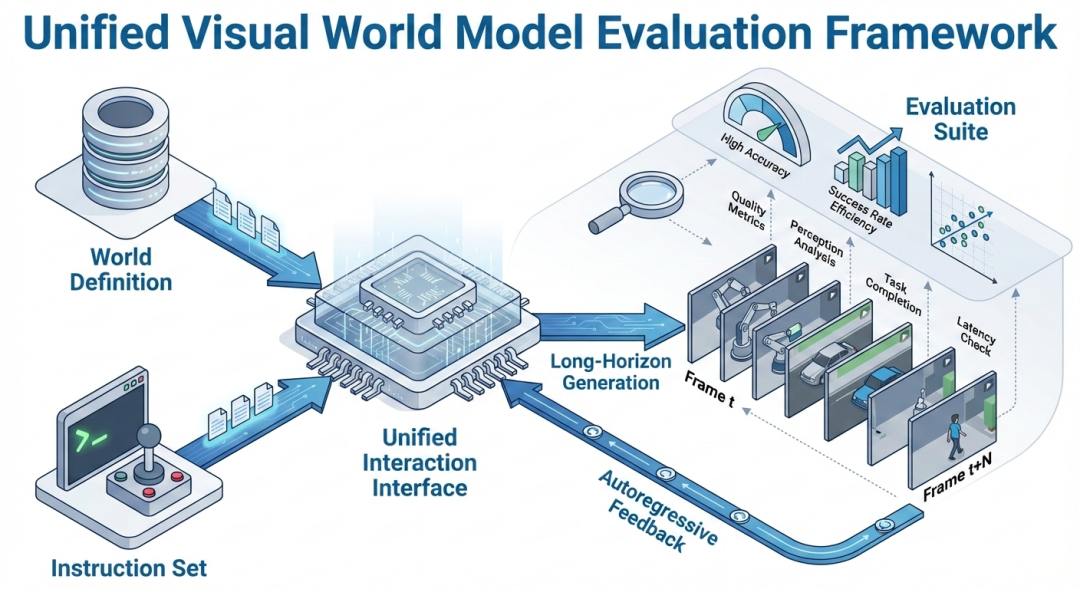
The Meituan LongCat team has officially introduced and open-sourced WBench, a pioneering evaluation benchmark designed specifically for interactive video world models. Described as a "CT scanner" for artificial intelligence, WBench provides a systematic framework for multi-round assessments, aiming to identify the specific limitations of current models as they transition from passive observation to active interaction. This development marks a significant milestone in understanding the boundaries of world models, ranging from lunar simulations to complex urban environments. By open-sourcing this tool, the team provides the industry with a precise diagnostic method to evaluate and improve the interactive capabilities and logical consistency of next-generation AI systems.
Key Takeaways
- Pioneering Framework: Meituan's LongCat team has released WBench, the first systematic multi-round evaluation benchmark for interactive video world models.
- Diagnostic Precision: The benchmark functions as a "CT scanner," allowing developers to pinpoint exactly where world models struggle during the transition from passive viewing to active interaction.
- Interactive Focus: Unlike traditional benchmarks, WBench emphasizes multi-round interaction, testing how models maintain consistency over repeated engagements.
- Open-Source Contribution: By open-sourcing WBench, Meituan is providing the global AI community with a standardized tool to measure the boundaries of world model capabilities.
In-Depth Analysis
Bridging the Gap Between Passive Viewing and Active Interaction
The emergence of world models has traditionally focused on "passive viewing"—the ability of an AI to generate or predict video sequences based on static prompts. However, the Meituan LongCat team identifies a critical bottleneck in the evolution of these models: the transition to "active interaction." WBench is designed to address this specific challenge. By implementing a systematic multi-round evaluation process, the benchmark tests whether a model can not only generate a coherent visual scene but also respond logically to user inputs or environmental changes over time. This shift is essential for applications in robotics, gaming, and autonomous systems, where a model must understand the consequences of actions within a simulated or real-world environment.
WBench as a Diagnostic "CT Scanner" for AI
The LongCat team describes WBench as a "CT scanner" for world models, a metaphor that underscores its role in deep diagnostic analysis. Current world models often show impressive results in short, non-interactive clips—such as a "moonwalk" or a flyover of a "cyber city"—but frequently break down when subjected to the rigors of multi-round interaction. WBench provides the granularity needed to see "inside" the model's logic, identifying where the spatial or temporal consistency fails. Whether the model loses track of object permanence or fails to calculate the physics of a specific interaction, WBench provides a structured way to map these boundaries. This precision allows researchers to move beyond general performance scores and focus on fixing specific architectural or training weaknesses.
Industry Impact
Standardizing World Model Evaluation
The introduction of WBench is a significant step toward standardizing how the industry evaluates world models. As more companies and research institutions develop large-scale video generation and simulation models, the lack of a common, interactive-focused benchmark has made it difficult to compare progress. WBench fills this void by providing a systematic, multi-round framework. This standardization is likely to accelerate the development of more robust AI systems, as it gives researchers a clear target for "interactive intelligence" rather than just visual fidelity.
Accelerating the Development of Interactive AI
By open-sourcing WBench, Meituan is lowering the barrier to entry for high-level AI diagnostics. Smaller research teams and independent developers can now utilize the same rigorous testing standards as major tech firms. This democratization of evaluation tools is expected to lead to a surge in innovation within the field of interactive world models. As models become better at handling the complex, multi-round scenarios presented in WBench—from lunar environments to dense urban landscapes—we can expect to see more reliable AI applications in fields that require high-stakes interaction and environmental understanding.
Frequently Asked Questions
Question: What is the primary purpose of WBench?
WBench is the first systematic multi-round evaluation benchmark designed to test the boundaries of interactive video world models. It helps identify where models fail when moving from passive observation to active, multi-round interaction.
Question: Who developed WBench and is it available to the public?
WBench was developed by the Meituan LongCat team. It has been open-sourced, making it available for the global AI research community to use for evaluating and improving their own world models.
Question: Why is the "multi-round" aspect of WBench important?
Multi-round evaluation is crucial because it tests a model's ability to maintain logical and visual consistency over a series of interactions. This is much more challenging than single-round generation and is a key requirement for truly interactive AI systems.