Meituan Launches LongCat-2.0: A 1.6 Trillion Parameter Model Trained on 50,000 Domestic Computing Cards
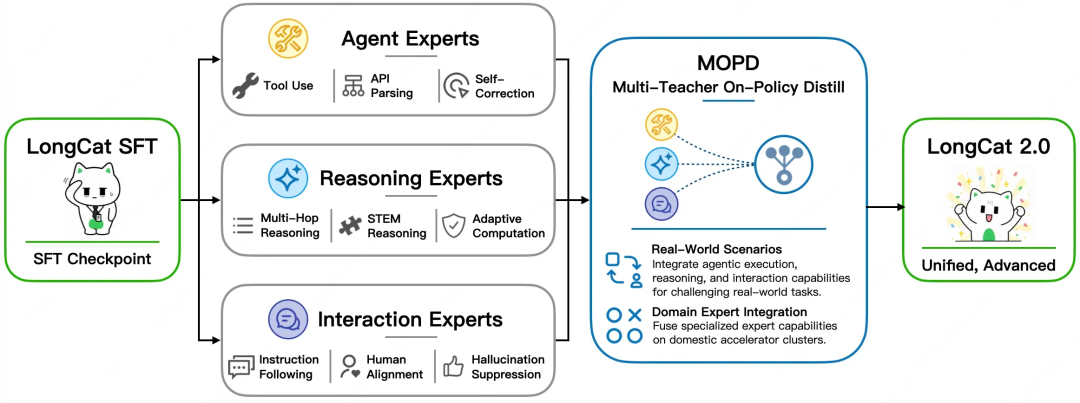
Meituan has officially announced the release of LongCat-2.0, a pioneering trillion-parameter large language model. This model represents a major technological milestone as the first in the industry to complete its entire training and inference lifecycle on a domestic computing cluster featuring 50,000 cards. LongCat-2.0 boasts a total of 1.6 trillion parameters, with an average activation of approximately 48 billion and a dynamic range of 33 billion to 56 billion. Pre-trained from scratch, the model natively supports a 1-million-token long context window. Its architecture is specifically designed to optimize Agentic Coding tasks, focusing on the efficient and stable understanding, generation, and execution of code in real-world scenarios.
Key Takeaways
- Massive Scale: LongCat-2.0 features 1.6 trillion total parameters, making it one of the largest models in the industry.
- Domestic Infrastructure: It is the first trillion-parameter model to complete full-process training and inference on a 50,000-card domestic computing cluster.
- Architectural Efficiency: While the total parameters reach 1.6T, the model utilizes a dynamic activation strategy with an average of 48B parameters (ranging from 33B to 56B) to balance performance and efficiency.
- Ultra-Long Context: The model natively supports a 1M (one million) token context window, specifically tailored for complex coding environments.
- Specialized Focus: The core design goal is "Agentic Coding," aiming to revolutionize code understanding, generation, and execution.
In-Depth Analysis
Breakthrough in Domestic Computing Power
The release of LongCat-2.0 by the Meituan technology team marks a significant shift in the landscape of high-performance computing and artificial intelligence. The most striking aspect of this announcement is the successful utilization of a 50,000-card domestic computing cluster for the entire lifecycle of a trillion-parameter model. This includes everything from the initial pre-training from scratch to the final inference stages.
In the current global climate, the ability to train a model of this magnitude—1.6 trillion parameters—on domestic hardware is a testament to the growing maturity of local computing infrastructure. Managing a cluster of 50,000 cards requires immense coordination, high-speed interconnectivity, and robust software-hardware co-optimization to prevent bottlenecks. Meituan's achievement demonstrates that domestic clusters have reached a level of stability and scale capable of supporting the world's most demanding AI workloads, effectively proving the feasibility of full-stack domestic AI development for ultra-large-scale models.
Architectural Innovation: Total vs. Active Parameters
LongCat-2.0 employs a sophisticated architectural design that distinguishes between total parameters and active parameters. With a total parameter count of 1.6 trillion, the model sits at the forefront of the "trillion-parameter club." However, the model does not activate all these parameters for every task. Instead, it features an average activation of approximately 48 billion parameters, with a dynamic range that fluctuates between 33 billion and 56 billion depending on the specific requirements of the input.
This dynamic activation strategy suggests a highly optimized Mixture-of-Experts (MoE) or a similar sparse architecture, although the original report focuses on the activation metrics. By only engaging a fraction of the total parameters (roughly 3% on average), LongCat-2.0 can maintain the high-level reasoning and knowledge capacity associated with trillion-parameter models while significantly reducing the computational cost and latency during inference. This balance is crucial for practical applications, ensuring that the model remains responsive and cost-effective even when handling complex tasks.
Native 1M Context and Agentic Coding
A defining feature of LongCat-2.0 is its native support for a 1-million-token context window. In the realm of software development, context is everything. Traditional models often struggle with large-scale repositories where understanding a single function might require knowledge of dependencies located thousands of lines away. By supporting 1M tokens, LongCat-2.0 can ingest entire codebases, documentation, and execution logs simultaneously.
This capability is the backbone of what Meituan calls "Agentic Coding." The model is not merely a code completion tool; it is designed to function as an agent that understands, generates, and executes code. The architecture was built from the ground up to ensure that this long-context capability translates into stability and efficiency in real-world coding tasks. For developers, this means the model can maintain a coherent understanding of a project's architecture, leading to more accurate code generation and more reliable execution within an autonomous or semi-autonomous coding environment.
Industry Impact
The launch of LongCat-2.0 has profound implications for the AI industry, particularly in the sectors of infrastructure and specialized AI agents. First, it validates the path of domestic self-reliance in AI hardware. By proving that a 1.6T model can be trained and deployed on a 50,000-card domestic cluster, Meituan has provided a blueprint for other organizations to follow, potentially reducing the industry's dependence on specific international hardware providers.
Second, the focus on "Agentic Coding" signals a shift from general-purpose LLMs toward highly specialized, task-oriented agents. As models become more capable of handling massive contexts and executing code, the role of the AI shifts from a passive assistant to an active participant in the software development lifecycle. This could lead to a significant increase in developer productivity and a transformation in how software is built, tested, and maintained. LongCat-2.0 sets a high bar for what specialized coding models can achieve in terms of scale and architectural efficiency.
Frequently Asked Questions
Question: What makes the 50,000-card cluster significant for LongCat-2.0?
It is the first time a trillion-parameter model (1.6T) has completed its full training and inference process on a domestic computing cluster of this scale. This proves that domestic hardware and software stacks are now capable of supporting the most intensive AI training requirements in the world.
Question: How does the dynamic parameter activation work in LongCat-2.0?
While the model has 1.6 trillion total parameters, it only activates a subset for any given task. On average, it uses 48 billion parameters, with the actual number varying between 33 billion and 56 billion. This allows the model to leverage the vast knowledge of a trillion-parameter system while operating with the speed and efficiency of a much smaller model.
Question: Why is the 1M context window important for coding?
In "Agentic Coding," the model needs to understand entire projects, not just snippets. A 1-million-token context window allows the model to process massive amounts of code and documentation at once, enabling it to understand complex dependencies and perform more stable code generation and execution across large repositories.