Meituan LongCat Team Unveils WBench: The First Systematic Benchmark for Interactive Video World Models
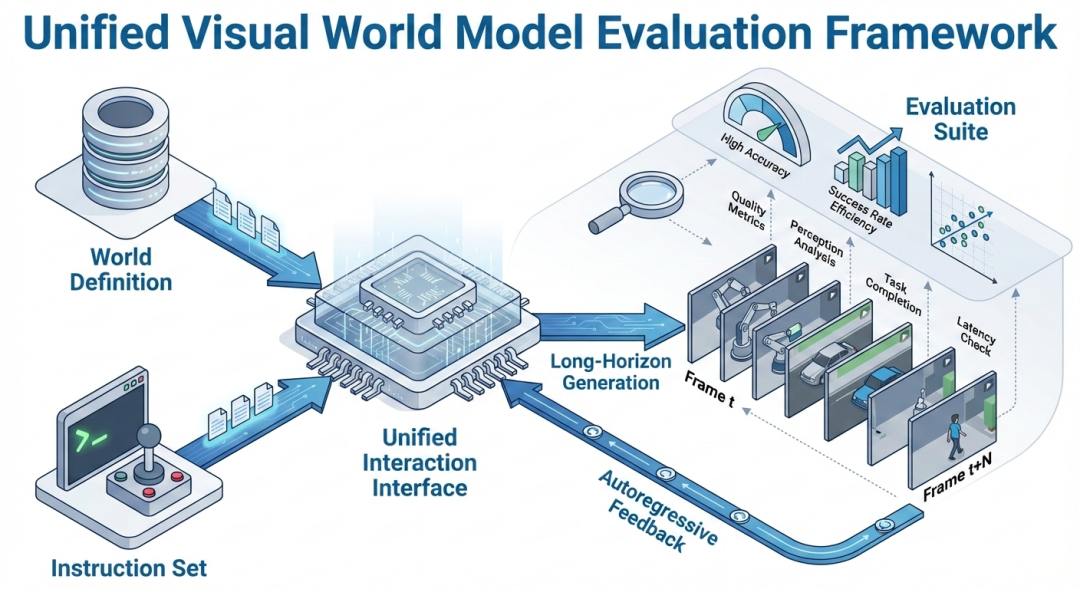
The Meituan LongCat team has officially announced the release and open-sourcing of WBench, a pioneering evaluation framework designed to measure the performance of interactive video world models. As the first systematic multi-round evaluation benchmark of its kind, WBench functions as a diagnostic "CT scanner" for artificial intelligence. It is specifically engineered to identify the technical bottlenecks that occur as world models transition from "passive viewing"—simply observing data—to "active interaction," where models must respond to and manipulate environments. This release marks a significant step in standardizing how the industry evaluates the boundaries and capabilities of complex world models in dynamic, multi-stage scenarios.
Key Takeaways
- Introduction of WBench: Meituan's LongCat team has developed and open-sourced WBench, the first systematic benchmark for interactive video world models.
- Multi-Round Evaluation: Unlike traditional single-step assessments, WBench focuses on multi-round interactions, providing a more comprehensive look at model consistency.
- Diagnostic Capabilities: The tool is described as a "CT scanner," capable of precisely locating where models fail during the transition from observation to interaction.
- Bridging the Gap: WBench addresses the critical boundary between "passive viewing" and "active interaction" in AI development.
- Open Source Contribution: By open-sourcing the benchmark, Meituan provides the AI community with a standardized tool to measure and improve world model boundaries.
In-Depth Analysis
Defining the Boundaries of World Models
The emergence of WBench by the Meituan LongCat team represents a pivotal shift in how the AI industry perceives and tests "world models." For a long time, the development of video-based AI has been focused on passive consumption—models that can predict the next frame or generate a video based on a static prompt. However, the true potential of a world model lies in its ability to act as a simulator for reality, which requires interactivity.
WBench is positioned as the first systematic tool to address this specific frontier. By focusing on "interactive video world models," the benchmark moves beyond simple visual fidelity and enters the realm of functional logic. The core challenge identified by the LongCat team is the transition from "passive viewing" to "active interaction." In a passive state, a model only needs to maintain visual continuity. In an active state, the model must maintain a coherent world state while responding to external inputs or multi-round changes, a task that has proven significantly more difficult for current architectures.
The "CT Scanner" Metaphor: Precision Diagnostics in AI
One of the most striking aspects of the WBench announcement is its description as a "CT scanner" for AI. This metaphor suggests that current evaluation methods for world models are perhaps too superficial, looking only at the "surface" of the generated output. WBench, conversely, is designed to look "inside" the model's logic and temporal consistency across multiple rounds of interaction.
By providing a systematic multi-round evaluation, WBench can pinpoint exactly where a model "gets stuck." This diagnostic precision is essential for researchers who need to understand whether a model's failure is due to a lack of spatial awareness, a breakdown in temporal logic, or an inability to process interactive commands. As world models are applied to increasingly complex tasks—from "moonwalks" to navigating "cyber cities"—having a tool that can map these boundaries becomes a prerequisite for further innovation.
Systematic Multi-Round Interaction
The "multi-round" nature of WBench is its most defining technical characteristic. In real-world scenarios, interaction is rarely a single event; it is a continuous loop of action and reaction. Traditional benchmarks often fail to capture the cumulative errors that occur over several steps of interaction. WBench's systematic approach ensures that world models are tested on their ability to maintain a stable and logical environment over time, even as they are subjected to repeated interactive prompts. This rigor is what allows WBench to measure the true "boundaries" of what a world model can and cannot do.
Industry Impact
The introduction of WBench is likely to have a profound impact on the AI research community and the broader industry. First, by open-sourcing the benchmark, Meituan is establishing a potential industry standard for a nascent but critical field. Standardized benchmarks are often the catalysts for rapid technological leaps, as they provide a clear target for researchers to aim for.
Second, the focus on "active interaction" signals a shift in the industry's focus toward more practical, agentic AI. World models that can pass the rigorous multi-round testing of WBench will be better suited for applications in robotics, autonomous systems, and high-fidelity simulations. By identifying the specific bottlenecks in current models, WBench provides a roadmap for the next generation of AI development, moving the field closer to creating truly immersive and responsive digital worlds.
Frequently Asked Questions
Question: What makes WBench different from existing AI benchmarks?
WBench is the first benchmark specifically designed for "interactive video world models" with a focus on "multi-round" evaluation. While other benchmarks might test image quality or single-frame prediction, WBench acts as a diagnostic tool to see how well a model handles continuous, active interaction over multiple stages.
Question: Why does the LongCat team describe WBench as a "CT scanner"?
The term "CT scanner" is used to highlight the benchmark's ability to perform deep, precise diagnostics. It doesn't just give a pass/fail grade; it identifies exactly where and why a world model fails when trying to transition from simply showing a video to interacting with a user or environment.
Question: What is the significance of "passive viewing" vs. "active interaction" in this context?
"Passive viewing" refers to a model's ability to generate or observe video without changing the state of the world based on input. "Active interaction" requires the model to understand the consequences of actions and update the video world accordingly. WBench measures the boundary where models currently struggle to make this transition.