Qwen 3.6 27B: The New Benchmark for Local AI Development and General Intelligence
The release of Qwen 3.6 27B marks a significant turning point for local AI development, positioning itself as the "sweet spot" for developers seeking high-tier general intelligence without relying on cloud-based APIs. According to industry analysis and hands-on testing by Piotr Migdał, the 27B dense model offers a superior balance of power and instruction-following capabilities compared to its Mixture-of-Experts (MoE) counterpart, the Qwen 3.6 35B A3B. While the model demands significant hardware resources—notably generating high thermal output during operation—it demonstrates a remarkable ability to handle complex tasks such as constrained creative writing and sophisticated coding. From generating functional hexagonal minesweeper games to synthesizing quantum physics with dance poetry, Qwen 3.6 27B proves that local models can now rival the performance of previous state-of-the-art proprietary systems like GPT-4.5.
Key Takeaways
- Superior Instruction Following: The Qwen 3.6 27B dense model demonstrates significantly better adherence to complex instructions compared to the faster 35B MoE variant.
- Local General Intelligence: It is recognized as one of the first local models to truly function as a general intelligence, capable of handling tasks previously reserved for high-end proprietary models.
- Coding Proficiency: The model successfully generated a complex hexagonal minesweeper using specific package managers (pnpm) on the first attempt, showcasing its utility for real-world development.
- High Thermal Demand: Running the model locally is resource-intensive, leading to high hardware temperatures, though the performance trade-off is considered worthwhile.
In-Depth Analysis
The Architecture Debate: Dense vs. Mixture-of-Experts
The release of Qwen 3.6 introduces a fascinating comparison between two architectural approaches: the dense 27B model and the 35B A3B Mixture-of-Experts (MoE) model. While MoE architectures are often praised for their speed and efficiency, the 27B dense model has emerged as the preferred choice for developers requiring precision. In practical testing, the 27B variant proved to be more powerful and reliable, particularly when tasks required strict adherence to structural constraints.
A prime example of this discrepancy was observed during a coding challenge to create a hexagonal minesweeper using the pnpm package manager. While the 35B MoE model was faster, it failed to follow the specific instruction to create a proper package, instead defaulting to a single HTML file. In contrast, the 27B dense model correctly initialized the project with the requested Node package structure on its first attempt. This suggests that for local development where accuracy outweighs raw generation speed, the dense architecture remains the superior "sweet spot."
Benchmarking Creative and Constrained Intelligence
Beyond technical coding, Qwen 3.6 27B has been subjected to various "smoke tests" to evaluate its reasoning and creative synthesis. One such test involved the "penguins on a bicycle" prompt, a common benchmark used by AI researchers like Simon Willison to gauge a model's ability to visualize and describe unusual scenarios. The 27B model handled these prompts with a level of nuance that suggests a deep understanding of context and spatial relationships.
Furthermore, the model's performance in constrained writing tasks—such as composing an eight-line poem that bridges the disparate worlds of Zouk dance and quantum physics—highlights its sophisticated thought process. The model did not merely generate rhymes; its internal deliberation (thought process) showed a genuine attempt to reconcile quantum terminology with the rhythmic elements of dance. This level of "vibe translation" was, until recently, only achievable by massive, expensive models like GPT-4.5, indicating that the gap between local and cloud-based AI is closing rapidly.
Hardware Realities and Local Deployment
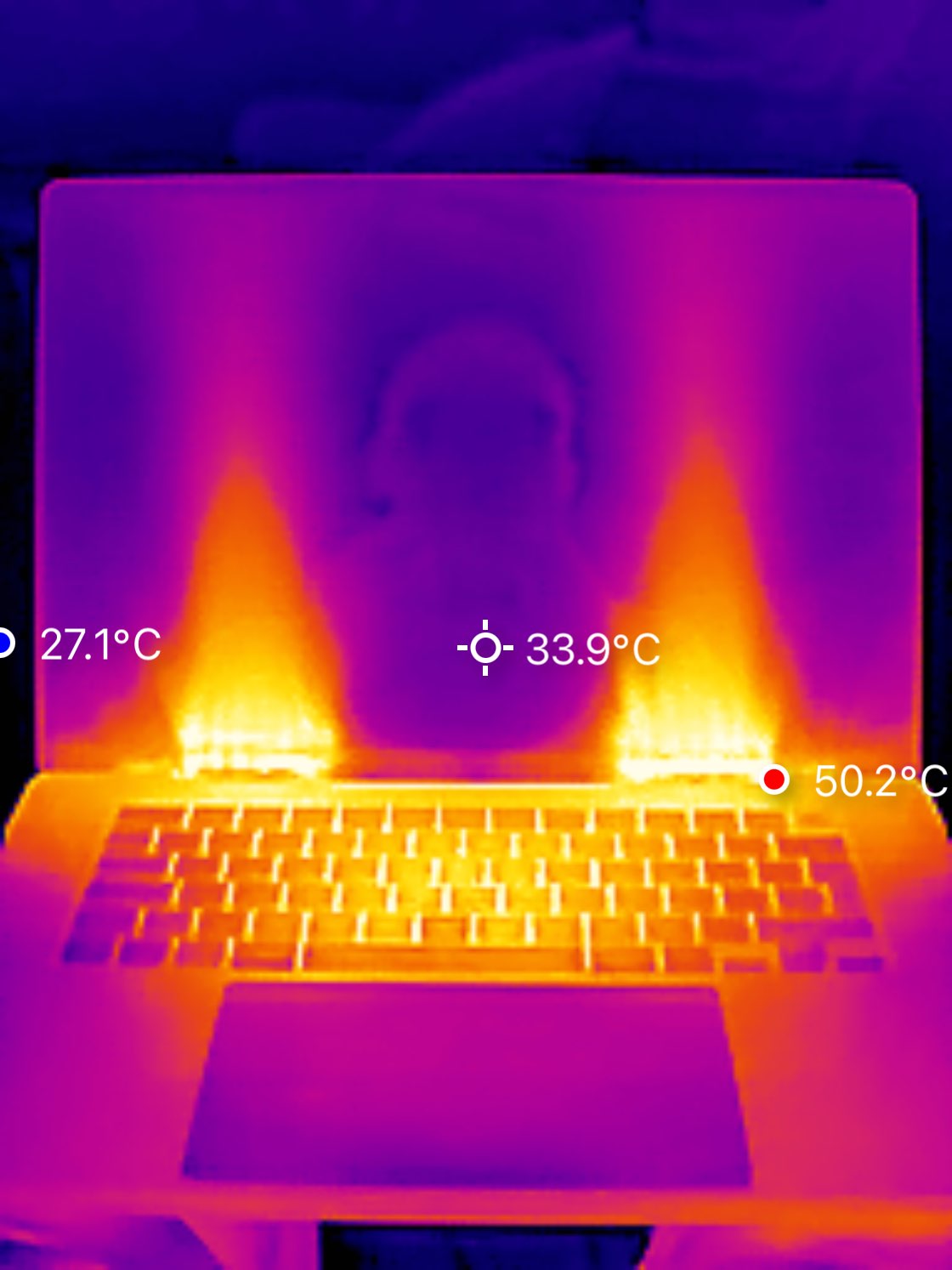
While the performance of Qwen 3.6 27B is impressive, it comes with significant physical costs. Users have reported that running the model locally pushes hardware to its limits, resulting in extreme thermal output. Thermal imaging of devices running the model shows intense heat generation, a reminder that "punching above its weight" in terms of intelligence requires a corresponding weight in computational energy.
Despite the heat, the consensus among the developer community, including groups like AI Tinkerers Warsaw, is that the trade-off is justified. The ability to run a model of this caliber locally provides developers with privacy, reduced latency for iterative tasks, and a level of control that cloud APIs cannot match. It represents a shift where the "day job" of a developer—performing regular, complex tasks—can now be supported by a local machine rather than a remote server.
Industry Impact
The emergence of Qwen 3.6 27B as a viable local general intelligence has profound implications for the AI industry. First, it challenges the dominance of closed-source, API-only models by providing a high-performance alternative that can be hosted on consumer-grade (albeit high-end) hardware. This democratization of power allows smaller firms and individual developers to build sophisticated applications without the recurring costs and privacy concerns associated with proprietary platforms.
Second, the success of the 27B dense model over the 35B MoE in instruction-following tasks may influence future model training strategies. It suggests that for specific professional use cases—such as software engineering and scientific research—scaling dense parameters may still offer a reliability advantage that MoE models have yet to fully replicate. As local hardware continues to evolve to handle these thermal and computational loads, the trend toward decentralized, local-first AI development is likely to accelerate.
Frequently Asked Questions
Question: Why is Qwen 3.6 27B considered better than the 35B MoE version?
While the 35B A3B MoE model is faster, the 27B dense model is more powerful and significantly better at following complex, multi-step instructions. In testing, the 27B model successfully handled specific project structures that the MoE model ignored.
Question: What kind of tasks can Qwen 3.6 27B handle locally?
It is capable of a wide range of tasks including complex coding (e.g., creating Node packages), constrained creative writing, and synthesizing complex scientific concepts. It is described as a "general intelligence" suitable for regular professional work.
Question: Does running Qwen 3.6 27B require special hardware?
While it can run on local development machines, it is highly resource-intensive. Users have noted that it generates significant heat, suggesting that robust cooling and a powerful GPU/CPU setup are necessary for sustained use.