Meituan Technical Team Releases LARYBench: A New Benchmark for Universal Latent Action Representation in Embodied AI
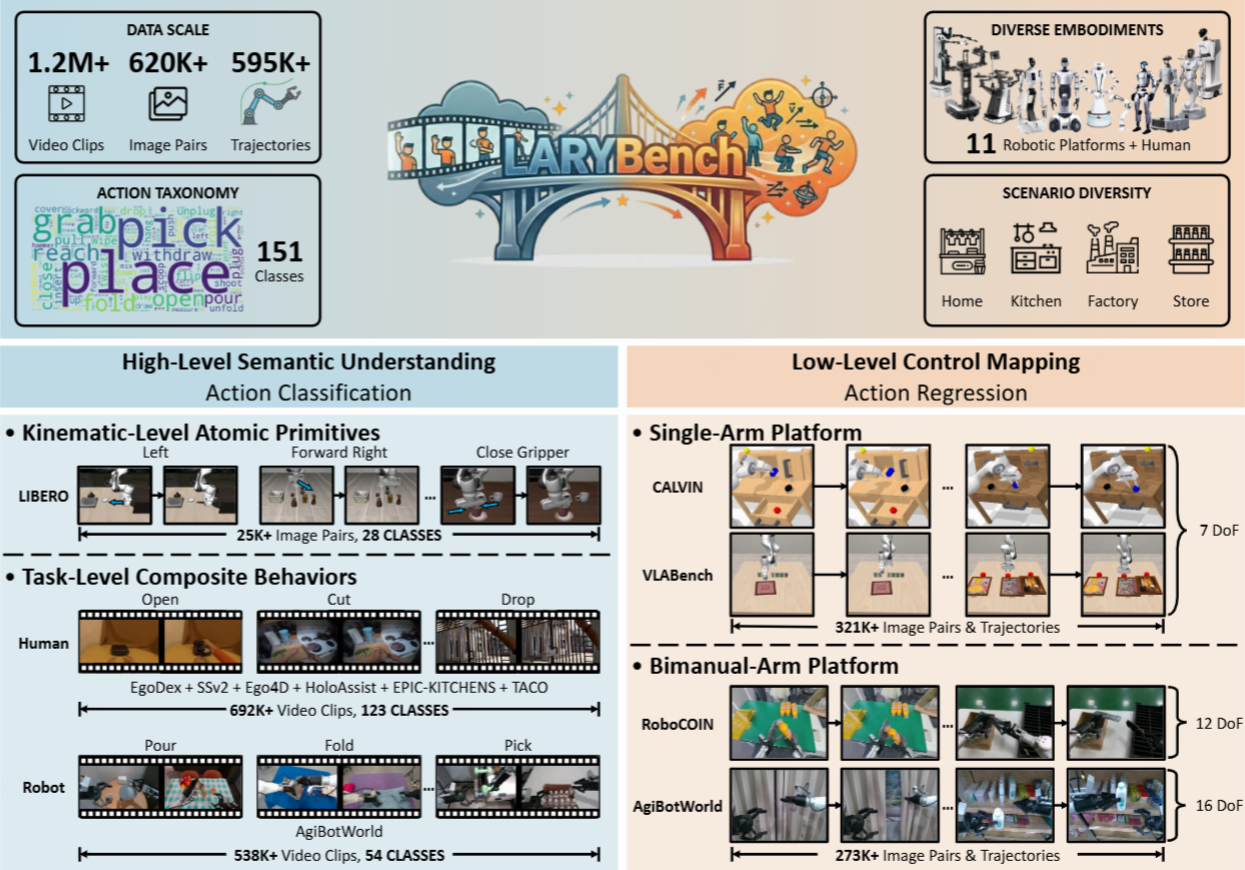
The Meituan Technical Team has officially introduced LARYBench (Latent Action Representation Yielding Benchmark), a systematic evaluation framework designed to guide the learning of universal latent action representations from large-scale visual data. This benchmark marks a significant milestone in embodied AI by providing a standardized way to measure how models learn actions from visual inputs. Experimental results from the benchmark reveal that general vision models significantly outperform specialized embodied action expert models in both action generalization and control precision. Furthermore, the research demonstrates that embodied action representations can naturally emerge from large-scale human video data, suggesting that broad visual training is a viable path toward achieving more sophisticated and adaptable robotic control systems.
Key Takeaways
- LARYBench Introduction: Meituan has launched the Latent Action Representation Yielding Benchmark (LARYBench) to evaluate universal latent action representations learned from visual data.
- Superiority of General Models: Experimental data indicates that general-purpose vision models outperform specialized embodied AI models in action generalization and control precision.
- Emergent Capabilities: Embodied action representations can emerge effectively from large-scale human video datasets, rather than requiring exclusively robot-specific data.
- New Standard for Embodied AI: LARYBench serves as a systematic guide for developing models that can translate visual information into actionable robotic intelligence.
In-Depth Analysis
Defining the ImageNet for Embodied Action
The release of LARYBench by the Meituan Technical Team represents a strategic shift in how the industry evaluates embodied intelligence. By positioning LARYBench as a systematic evaluation benchmark, the team aims to provide a framework similar to what ImageNet did for computer vision. The core focus of this benchmark is "Latent Action Representation," which refers to the underlying mathematical understanding a model has regarding physical movements and actions. By learning these representations from large-scale visual data, AI systems can potentially bridge the gap between seeing an action and performing it.
General Vision Models vs. Specialized Experts
One of the most striking findings revealed by the LARYBench experiments is the performance gap between general vision models and specialized embodied action models. Traditionally, the industry has leaned toward developing "expert" models specifically trained on robotic datasets to handle control tasks. However, the LARYBench results show that general vision models—those trained on vast, diverse visual datasets—exhibit significantly better action generalization and control precision. This suggests that the broad features learned by general-purpose models provide a more robust foundation for embodied tasks than the narrow focus of specialized models.
The Role of Human Video Data in Action Learning
LARYBench highlights a critical breakthrough in data sourcing for embodied AI: the emergence of action representations from human video data. The benchmark demonstrates that models do not necessarily need to be trained solely on teleoperated robot data or simulated environments to understand movement. Instead, by processing large-scale videos of humans performing various tasks, these models can develop an implicit understanding of actions. This "emergence" of embodied representation from human-centric data opens new doors for scaling AI training, as human video data is far more abundant and easier to collect than specialized robotic execution data.
Industry Impact
The introduction of LARYBench is poised to influence the AI industry in several key ways. First, it provides a clear metric for researchers to measure the "generalization" capabilities of their models, which has long been a hurdle in robotics. Second, the discovery that general vision models are superior to specialized ones may lead to a consolidation of research efforts, where developers focus on fine-tuning large-scale foundation models for embodied tasks rather than building niche models from scratch. Finally, the validation of human video data as a primary training source could accelerate the development of humanoid robots and autonomous systems by leveraging the vast amount of video content already available on the internet.
Frequently Asked Questions
Question: What is the primary purpose of LARYBench?
LARYBench (Latent Action Representation Yielding Benchmark) is designed to be a systematic evaluation system that guides and measures how AI models learn universal latent action representations from large-scale visual data.
Question: Why are general vision models performing better than specialized models in this benchmark?
According to the experimental results, general vision models demonstrate superior action generalization and control precision. This suggests that the diverse features and broad patterns learned by general models are more effective for embodied intelligence than the narrow training of specialized action expert models.
Question: Can robots learn how to move just by watching videos of humans?
Yes, the LARYBench findings indicate that embodied action representations can emerge from large-scale human video data. This means that models can learn the underlying logic of actions and movements by observing human behavior, which can then be applied to robotic control.