
LARYBench Released: Defining the ImageNet for Embodied Action Representation and Learning from Human Video Data
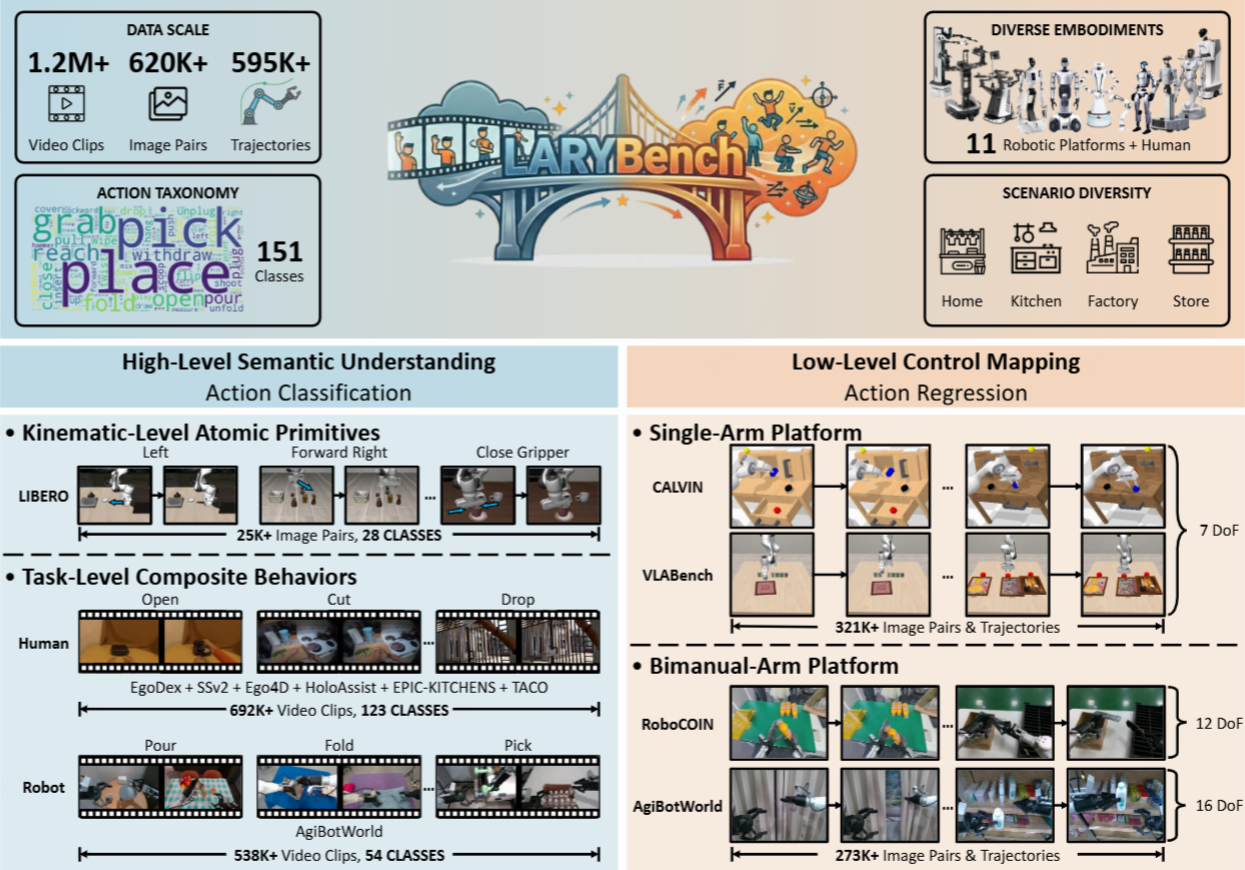
The Meituan Technical Team has officially released LARYBench (Latent Action Representation Yielding Benchmark), a systematic evaluation framework designed to guide the development of general latent action representations from large-scale visual data. This benchmark represents a significant milestone in embodied intelligence, aiming to provide a standardized metric similar to how ImageNet transformed computer vision. Experimental results from the benchmark reveal a critical shift in AI development: general-purpose vision models significantly outperform specialized embodied AI action expert models in both action generalization and control precision. Furthermore, the research demonstrates that sophisticated embodied action representations can naturally emerge from large-scale human video data, suggesting that specialized training on robotic-specific datasets may not be the only path to high-performance embodied AI.
Key Takeaways
- Introduction of LARYBench: A systematic benchmark designed to evaluate and guide the learning of general latent action representations from visual datasets.
- Superiority of General Models: General vision models demonstrate significantly better performance in action generalization and control precision compared to specialized embodied expert models.
- Emergent Action Representations: Embodied action capabilities can emerge from large-scale human video data, reducing the sole reliance on specialized robotic datasets.
- Standardizing Embodied AI: LARYBench aims to serve as the 'ImageNet' for the field of embodied action representation, providing a clear metric for progress.
In-Depth Analysis
The Strategic Role of LARYBench in Embodied Intelligence
The release of LARYBench (Latent Action Representation Yielding Benchmark) by the Meituan Technical Team marks a pivotal moment in the evolution of embodied AI. For years, the industry has struggled with the lack of a unified, systematic benchmark to measure how well models can translate visual perception into actionable latent representations. LARYBench addresses this gap by providing a framework that specifically targets the learning of general latent action representations from large-scale visual data. By establishing this benchmark, the research team is essentially defining the 'ImageNet' for the embodied AI era, creating a standardized environment where different architectures and training methodologies can be compared with scientific rigor.
The benchmark focuses on the transition from raw visual input to a latent space that represents potential actions. This is a critical step for robots and autonomous systems that must understand not just what they see, but how what they see relates to physical movement and interaction. The systematic nature of LARYBench allows researchers to identify which models are truly capable of understanding the underlying physics and intent of actions, rather than simply memorizing specific trajectories.
General Vision Models vs. Specialized Action Experts
One of the most striking findings revealed by the LARYBench experiments is the performance gap between general vision models and specialized embodied action expert models. Traditionally, the prevailing wisdom in robotics and embodied AI was that specialized models, trained specifically on robotic control data, would naturally outperform general-purpose models in tasks requiring high precision and generalization. However, LARYBench results indicate the opposite: general vision models are significantly superior in both action generalization and control precision.
This finding suggests that the broad features learned by general vision models—likely due to their exposure to vast and diverse visual datasets—provide a more robust foundation for action representation than the narrow features learned by specialized experts. Generalization is particularly important in embodied AI, as robots must operate in unpredictable, real-world environments. The fact that general models excel in this area implies that the path to advanced embodied intelligence may lie in leveraging and fine-tuning large-scale foundational vision models rather than building niche expert systems from scratch. The precision aspect is equally vital, showing that general models do not sacrifice accuracy for their breadth of knowledge.
The Emergence of Action from Human Video Data
Perhaps the most transformative insight provided by the LARYBench research is the confirmation that embodied action representations can emerge from large-scale human video data. This challenges the notion that embodied AI requires massive amounts of specialized, robot-collected data (such as teleoperation or simulation data) to learn how to move and interact with the world. Instead, by observing the vast library of human actions captured in video, general models can internalize the latent structures of movement, force, and spatial interaction.
This 'emergence' of action representation from passive observation of humans suggests a highly scalable path forward for the industry. Human video data is far more abundant and easier to collect than specialized robotic data. If models can learn the fundamentals of embodied action through these datasets, the bottleneck of data collection in robotics could be significantly alleviated. LARYBench provides the first systematic measurement of this phenomenon, proving that the latent representations required for control are already being formed within models trained on diverse human-centric visual information.
Industry Impact
The introduction of LARYBench and its subsequent findings are poised to reshape the priorities of the AI and robotics industries. By demonstrating that general vision models are more effective than specialized experts, the benchmark encourages a shift in resource allocation toward the development of more powerful foundational vision models that can be adapted for embodied tasks. This could lead to a more unified approach to AI development, where the boundaries between computer vision and robotics continue to blur.
Furthermore, the validation that human video data can drive the emergence of action representations provides a clear roadmap for scaling embodied AI. Companies and research institutions can now focus on leveraging existing video repositories to train the next generation of autonomous systems. LARYBench provides the necessary yardstick to measure this progress, ensuring that as models grow in scale, their ability to represent and execute actions improves in a measurable and predictable way. This standardization is essential for the commercialization of embodied AI, as it provides a reliable framework for evaluating the safety, precision, and adaptability of robotic systems before they are deployed in real-world scenarios.
Frequently Asked Questions
Question: What is the primary purpose of LARYBench?
LARYBench is a systematic evaluation benchmark designed to measure and guide the learning of general latent action representations from large-scale visual data. It aims to provide a standardized metric for the field of embodied intelligence, similar to the role ImageNet played for computer vision.
Question: Why did general vision models outperform specialized expert models in the LARYBench tests?
The benchmark results indicate that general vision models possess superior action generalization and control precision. This is likely because the broad, diverse features learned by general models during large-scale training provide a more robust basis for understanding complex actions than the narrow, task-specific training of specialized expert models.
Question: Can robots learn to move just by watching videos of humans?
According to the LARYBench findings, yes. The research demonstrates that embodied action representations can emerge from large-scale human video data. This suggests that models can learn the latent structures of physical action by observing human behavior, which can then be applied to robotic control and embodied AI tasks.

