
Meituan Open-Sources LongCat-Flash-Prover: Advancing AI from Numerical Calculation to Rigorous Mathematical Theorem Proving
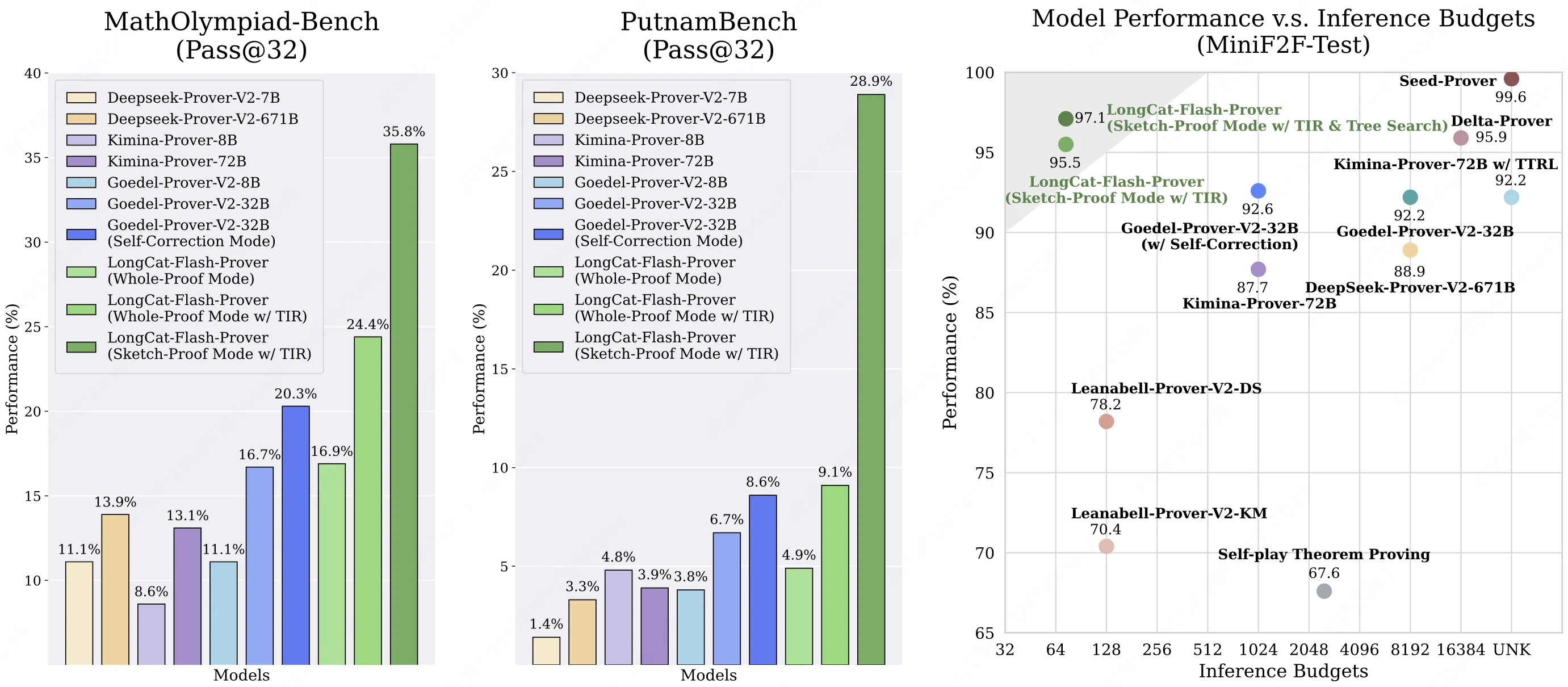
The Meituan Technical Team has announced the open-sourcing of LongCat-Flash-Prover, a specialized model designed to tackle the complexities of mathematical formalization and theorem proving. While traditional AI models often focus on achieving correct numerical outputs, LongCat-Flash-Prover addresses the more demanding requirement of maintaining strict logical chains. By focusing on formalization, the model seeks to eliminate the risks associated with natural language ambiguity, which can cause mathematical proofs to fail. This release marks a significant shift in AI development, moving from models that merely "guess" answers to systems capable of providing rigorous, verifiable mathematical proofs through structured reasoning.
Key Takeaways
- Open-Source Release: Meituan has officially open-sourced LongCat-Flash-Prover, a model dedicated to mathematical formalization.
- Rigorous Logic: The model prioritizes strict logical chains over simple numerical accuracy, addressing the core requirements of theorem proving.
- Eliminating Ambiguity: LongCat-Flash-Prover is designed to overcome the pitfalls of natural language ambiguity that often lead to the collapse of complex proofs.
- Shift in AI Capability: The project represents a transition from AI "guessing" answers to AI performing verifiable, rigorous mathematical demonstrations.
In-Depth Analysis
From Numerical Accuracy to Logical Rigor
In the current landscape of artificial intelligence, mathematical problem-solving has largely been measured by the ability of a model to reach the correct final value. However, the Meituan Technical Team identifies a critical distinction between "calculating correctly" and "proving rigorously." While standard numerical tasks allow for a margin of error or pattern-based guessing, mathematical theorem proving requires an uncompromising adherence to logical steps.
LongCat-Flash-Prover is introduced as a solution to this challenge. The model is built on the premise that a single ambiguous statement in natural language can invalidate an entire proof. By focusing on the structural integrity of the reasoning process, the model ensures that each step in a mathematical argument is logically sound and interconnected, preventing the "collapse" of the proof that often occurs in less specialized models.
The Challenge of Mathematical Formalization
One of the primary hurdles in complex reasoning is the transition from natural language to formal mathematical logic. Natural language is inherently flexible and often imprecise, which stands in direct opposition to the requirements of formal theorem proving. LongCat-Flash-Prover addresses this by specializing in mathematical formalization.
This process involves translating mathematical concepts into a structured format that can be verified with absolute certainty. By providing a model specifically tuned for this task, Meituan aims to move AI beyond the role of a calculator and into the role of a formal prover. This shift is essential for tackling high-level mathematical problems where the "how" and "why" of a solution are just as important as the final result. The model's design focuses on maintaining the continuity of the logical chain, ensuring that the transition from one step to the next is mathematically valid and free from the vagueness of standard linguistic processing.
Industry Impact
The release of LongCat-Flash-Prover signifies a maturing of AI applications in the field of complex reasoning. By open-sourcing a model that prioritizes formalization and logical rigor, Meituan is contributing to a broader industry movement toward "verifiable AI." This is particularly significant for sectors that require absolute precision, such as cryptography, advanced engineering, and theoretical research.
Furthermore, by addressing the fragility of logical chains in AI models, this development sets a new benchmark for how AI handles multi-step reasoning tasks. It encourages the industry to look beyond simple accuracy metrics and focus on the reliability and transparency of the underlying logic. As AI continues to integrate into scientific and mathematical workflows, tools like LongCat-Flash-Prover will be instrumental in ensuring that machine-generated insights are grounded in rigorous, formal proof rather than statistical probability.
Frequently Asked Questions
Question: How does LongCat-Flash-Prover differ from standard math-solving AI models?
Standard AI models typically focus on "guessing" the correct final numerical answer. In contrast, LongCat-Flash-Prover is designed for theorem proving, which requires a strict, step-by-step logical chain and formalization to ensure the entire proof is rigorous and verifiable.
Question: Why is natural language ambiguity a problem for mathematical proofs?
In mathematical theorem proving, every statement must be precise. Natural language often contains ambiguities that can lead to multiple interpretations. If a model uses an ambiguous term or logic in a proof, the entire logical chain can collapse, making the proof invalid. LongCat-Flash-Prover aims to solve this by focusing on formalization.
Question: What is the primary goal of open-sourcing LongCat-Flash-Prover?
The primary goal is to provide a specialized tool for mathematical formalization and theorem proving, helping the AI community move from simple numerical calculations to more complex, rigorous, and logically sound reasoning tasks.