
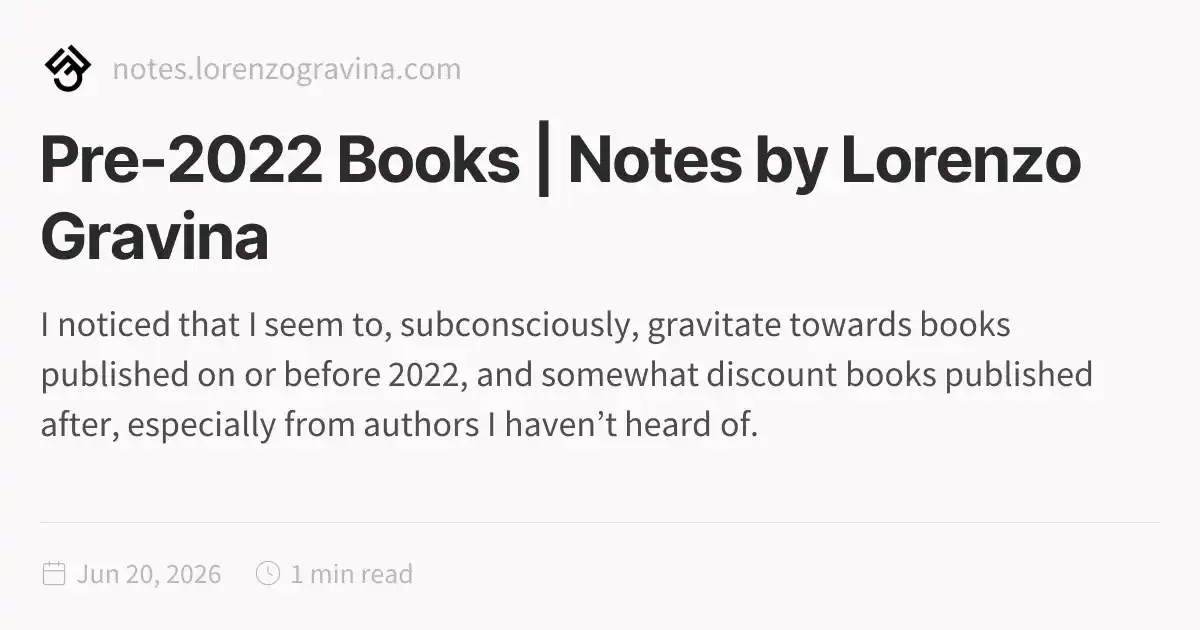
The Value of Human Effort: Why Readers Are Gravitating Toward Pre-2022 Books in the Age of AI
A growing sentiment among readers suggests a subconscious preference for books published on or before 2022, driven by the perceived value of manual human labor. While Large Language Models (LLMs) have become essential tools for tasks like coding, their influence on the publishing industry has sparked a unique skepticism toward newer works, particularly from unknown authors. The core of this preference lies in the assurance that pre-2022 texts underwent a rigorous, manual process of typing, editing, and proofreading. This reflection highlights a tension between the efficiency of AI tools and the traditional weight given to human-crafted content. As society navigates this technological shift, the industry faces questions about how the 'effort' behind a creative work influences its perceived authority and value in a post-AI world.
Key Takeaways
- Subconscious Bias: There is an emerging tendency to favor books published before 2022, viewed as a benchmark for purely human-authored content.
- The Effort Metric: The manual labor involved in pre-2022 publishing—typing, editing, and proofreading—adds a perceived 'weight' and credibility to the text.
- Skepticism of New Authors: Books published after the rise of LLMs, especially by unknown writers, face greater scrutiny regarding their origin and quality.
- Technological Paradox: Even those who utilize and appreciate AI for technical tasks like coding may still harbor a preference for human-only creative works.
- Historical Context: This shift in perception mirrors past societal anxieties regarding the introduction of the printing press, radio, television, and the internet.
In-Depth Analysis
The Psychological Weight of Manual Craftsmanship
The preference for pre-2022 literature is rooted in the recognition of the intensive manual processes that defined the pre-AI era. When a reader engages with a book from this period, there is an inherent understanding that every word was the result of a deliberate human action. The author notes that the acts of manual typing, manual checking, manual editing, and manual proofreading contribute to the overall authority of the work. This 'effort' is not merely a logistical detail but a psychological anchor that leads readers to give greater weight to the arguments and narratives presented. In the absence of AI assistance, the finished product serves as a testament to sustained human focus and labor, which some readers find more trustworthy than the potentially frictionless output of modern generative tools.
Navigating the Post-2022 Trust Gap
The emergence of Large Language Models has introduced a new layer of skepticism into the relationship between author and reader. This is particularly evident in the treatment of authors who have not yet established a reputation. For books published after 2022, the subconscious mind of the reader may 'discount' the work, questioning whether the quality is a result of the author's skill or the capabilities of a tool. While the author acknowledges that the end result—if good—should theoretically justify the tool used, the emotional and intellectual connection to the work remains tied to the perceived effort. This creates a challenging landscape for new writers in the post-2022 era, as they must overcome a bias that equates 'manual' with 'meaningful.'
Historical Precedents and the Evolution of Tools
The current unease regarding AI-assisted writing is not an isolated phenomenon but part of a long history of technological transitions. The author draws parallels to previous eras where society 'worried' about the impact of writing, the printing press, newspapers, radio, television, and the internet on human intelligence and culture. Each of these milestones was met with a fear of 'dumbing down' society. However, the current shift feels distinct because it touches upon the very essence of creative effort. While the author admits that resisting this change might be akin to 'yelling at the clouds,' the sentiment persists that the transition to AI tools represents a fundamental change in how we value the written word. The resolution to this tension may simply be a matter of time and adaptation as society becomes accustomed to the presence of LLMs in the creative process.
Industry Impact
Redefining Authenticity in Publishing
The publishing industry may see a rise in the marketing of 'human-only' content as a premium feature. If readers continue to gravitate toward books that guarantee manual effort, publishers might need to implement more transparent disclosures regarding the use of AI in the writing and editing process to maintain trust with their audience.
The Challenge for Emerging Authors
New authors entering the market post-2022 face a unique hurdle. Without a pre-existing reputation, their work may be unfairly categorized as 'AI-generated' or 'low-effort.' This could lead to a shift in how authors build platforms, emphasizing their personal process and the manual stages of their work to differentiate themselves from purely algorithmic content.
The Coexistence of AI and Human Creativity
As the author notes, LLMs are already proving their worth in technical fields like coding. The industry impact will likely be a bifurcated market where AI is accepted for utility-driven content, while a niche but significant segment of the market remains dedicated to 'pre-2022 style' manual craftsmanship. The long-term impact will depend on whether the 'weight' of human effort remains a priority for future generations of readers.
Frequently Asked Questions
Question: Why is 2022 used as the specific cutoff point for this preference?
2022 is generally recognized as the year when Large Language Models (LLMs) became widely accessible and began to significantly influence content creation. Books published before this date are viewed as being free from the influence of generative AI, ensuring that the work was produced through traditional manual methods.
Question: Does the preference for older books mean the reader dislikes AI technology?
Not necessarily. The author explicitly mentions using and liking LLMs for coding work and acknowledges that these tools can produce great results. The preference is specifically related to the 'weight' and 'effort' perceived in the medium of books and literature, rather than a total rejection of the technology.
Question: Is there a proposed solution to this bias against post-2022 books?
The author suggests that there may not need to be a solution. It is possible that as society becomes more familiar with AI as a tool, the current skepticism will fade, and readers will move on and adapt to the new reality of content creation, much like they did with the advent of the internet or the printing press.

