
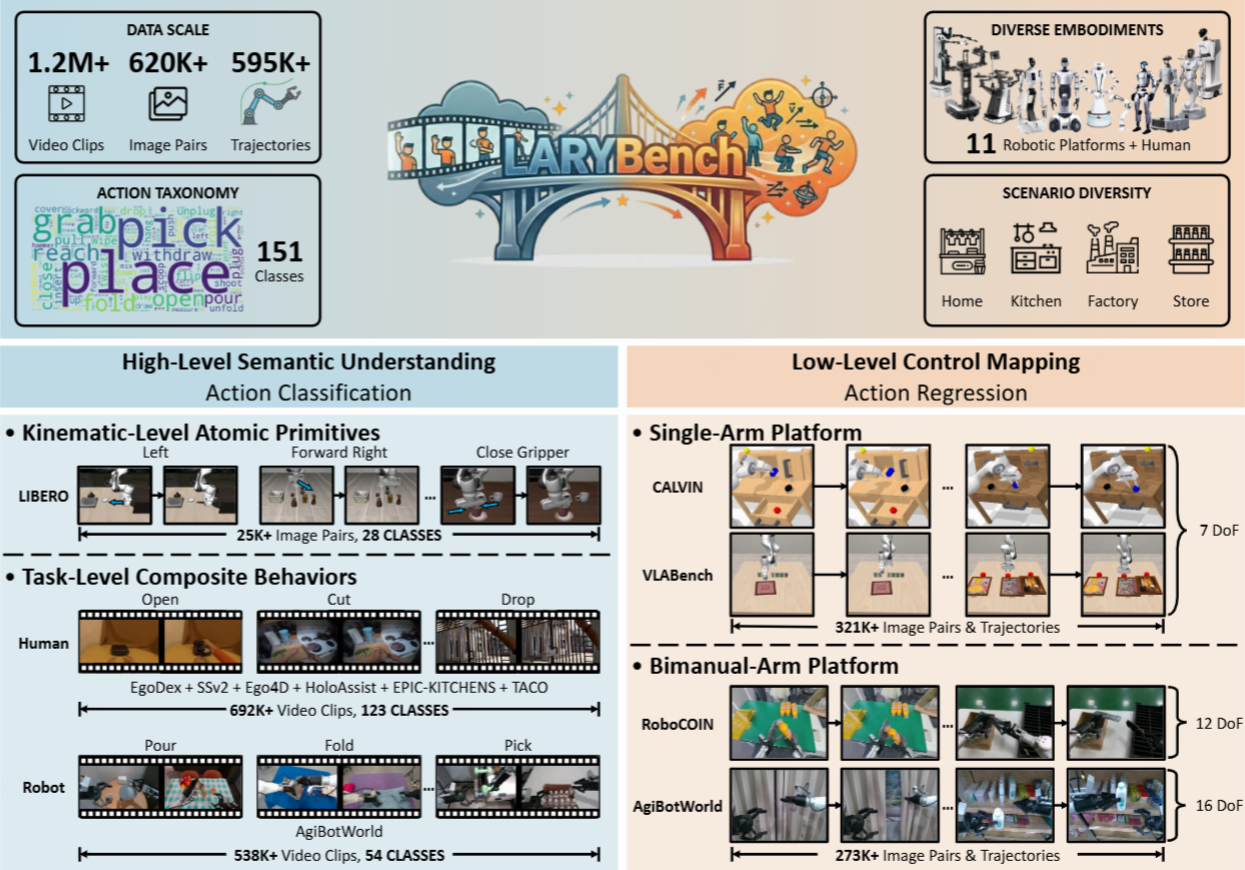
LARYBench Released: Defining the ImageNet for Embodied Action Representations and Measuring Generalization from Human Videos
Meituan Technical Team has officially released LARYBench (Latent Action Representation Yielding Benchmark), a systematic framework designed to evaluate and guide the learning of general latent action representations from large-scale visual data. The benchmark's findings represent a significant breakthrough in embodied AI, revealing that general vision models outperform specialized action expert models in both action generalization and control precision. Most notably, the research demonstrates that embodied action representations can emerge naturally from large-scale human video data. By establishing a standardized metric for action representation, LARYBench aims to serve as the 'ImageNet' for the field of embodied intelligence, providing a clear path for developing more versatile and precise robotic control systems based on universal visual foundations.
Key Takeaways
- Introduction of LARYBench: A new systematic evaluation benchmark designed to measure and guide the development of general latent action representations from visual datasets.
- Superiority of General Models: Experimental evidence shows that general vision models significantly outperform specialized embodied AI action expert models in terms of generalization and control precision.
- Emergence from Human Video: The research confirms that embodied action representations can emerge from large-scale human video data, suggesting a scalable path for robotic learning.
- Standardizing Embodied AI: LARYBench is positioned as the 'ImageNet' for embodied action, providing a foundational metric for the industry to measure progress in action representation.
In-Depth Analysis
The Genesis of LARYBench and Latent Action Representation
The Meituan Technical Team has introduced LARYBench, which stands for Latent Action Representation Yielding Benchmark. This system is designed to address a critical gap in the field of embodied intelligence: the lack of a systematic way to evaluate how well a model learns to represent actions from visual data. In the context of AI, a "latent action representation" refers to the underlying mathematical understanding of movement and interaction that a model derives from observing visual inputs. By creating a benchmark specifically for these representations, the researchers are providing a roadmap for how models can transition from simply seeing the world to understanding how to act within it.
LARYBench focuses on learning from large-scale visual data, which is essential for creating models that are not limited to specific, narrow tasks. The benchmark serves as a rigorous testing ground to determine if the representations learned by a model are truly "general"—meaning they can be applied across different environments and tasks—rather than being overfitted to a single scenario.
General Vision Models vs. Specialized Action Experts
One of the most striking findings revealed by the LARYBench experiments is the performance gap between general vision models and specialized embodied AI action expert models. Traditionally, the industry has often leaned toward building "expert" models—AI systems specifically trained and fine-tuned for a single robotic task or a narrow set of embodied actions. However, the data from LARYBench suggests a paradigm shift.
According to the experimental results, general vision models—those trained on vast and diverse visual datasets—exhibit significantly better performance in two critical areas: action generalization and control precision. Action generalization refers to the model's ability to take what it has learned in one context and apply it to a new, unseen situation. Control precision involves the accuracy and stability of the physical movements dictated by the model. The fact that general-purpose models outperform specialized ones suggests that a broad visual understanding of the world is a more effective foundation for embodied intelligence than narrow, task-specific training.
The Emergence of Action from Human Video Data
A core conclusion of the LARYBench research is that embodied action representations can "emerge" from large-scale human video data. This is a profound discovery for the scaling of embodied AI. Human videos are abundant and contain a wealth of information about how physical objects are manipulated, how bodies move through space, and the causal relationships between actions and outcomes.
The research indicates that by processing these massive amounts of human video, general vision models can internalize the principles of action without requiring explicit, manual labeling of every movement. This "emergence" implies that the path to more capable robots and embodied agents may lie in leveraging the vast repositories of existing human video content, rather than relying solely on expensive and difficult-to-collect robot-specific data. This positions LARYBench not just as a tool for measurement, but as a proof of concept for a new era of data-driven robotic intelligence.
Industry Impact
The release of LARYBench is likely to have a transformative effect on the embodied AI industry. By being described as the "ImageNet" for embodied action representation, it sets a new standard for how research and development will be conducted in this space. Just as ImageNet accelerated the field of computer vision by providing a massive, standardized dataset for image recognition, LARYBench provides the necessary infrastructure to benchmark how AI systems understand and execute actions.
For the AI industry, this shift emphasizes the importance of general-purpose visual foundations. Companies and researchers may move away from creating fragmented, task-specific models and instead focus on pre-training large-scale vision models that can then be adapted for various embodied tasks. Furthermore, the validation that human video data is a viable source for action learning opens up new possibilities for data collection and model training, potentially lowering the barrier to entry for developing high-precision robotic systems.
Frequently Asked Questions
Question: What is the primary purpose of LARYBench?
LARYBench (Latent Action Representation Yielding Benchmark) is a systematic evaluation framework designed to measure how effectively AI models learn general latent action representations from large-scale visual data. It aims to provide a standardized metric for the field of embodied intelligence, similar to what ImageNet did for computer vision.
Question: Why are general vision models performing better than specialized expert models?
According to the research, general vision models demonstrate superior action generalization and control precision. This suggests that a broad, comprehensive understanding of visual data provides a more robust foundation for learning actions than models that are narrowly specialized for specific embodied tasks.
Question: Can AI learn how to move just by watching videos of humans?
Yes, the LARYBench results indicate that embodied action representations can emerge from large-scale human video data. This means that by observing human movements and interactions in videos, models can develop a general understanding of action that can be applied to robotic control and embodied AI.

