High-Bandwidth Memory Costs Surge to 63% of AI Chip Components as Total Spending Hits $52 Billion
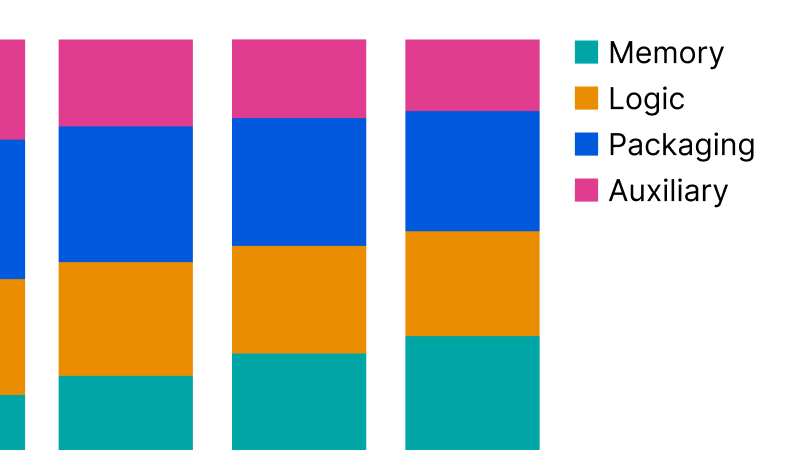
A comprehensive analysis by Epoch AI reveals a significant shift in the cost structure of artificial intelligence hardware, with High-Bandwidth Memory (HBM) now accounting for nearly two-thirds of total component spending. Between Q1 2024 and Q4 2025, HBM's share of costs for chips designed by industry leaders including Nvidia, AMD, Google, and Amazon rose from 52% to 63%. While logic die costs remained stable, the relative share of advanced packaging and auxiliary components declined. Total component spending is projected to reach $52 billion in 2025, driven by a massive $20 billion increase in HBM expenditures. This trend is forcing major hyperscalers like Microsoft and Meta to significantly increase their capital expenditure forecasts for 2026 to accommodate rising component prices and persistent supply constraints.
Key Takeaways
- HBM Dominance: High-bandwidth memory (HBM) share of total AI chip component costs grew from 52% in Q1 2024 to 63% by Q4 2025.
- Spending Explosion: Total component spending for major AI chip designers is projected to jump from $22 billion in 2024 to $52 billion in 2025.
- Component Cost Shifts: Logic die costs remained stable at 13-14%, while advanced packaging fell from 19% to 15% and auxiliary components dropped from 15% to 9%.
- Hyperscaler Adjustments: Microsoft and Meta are increasing their 2026 capital expenditure by billions of dollars specifically to account for rising component prices.
- Future Outlook: HBM is expected to claim an even larger share of costs in 2026 due to tight supply and rising market prices.
In-Depth Analysis
The Rising Financial Weight of High-Bandwidth Memory
According to data insights from Epoch AI, the economic landscape of AI chip manufacturing is undergoing a rapid transformation. High-bandwidth memory (HBM) has emerged as the most significant cost driver in the production of AI hardware. Between the first quarter of 2024 and the final quarter of 2025, HBM's share of total component spending increased from 52% to 63%. This calculation represents a weighted average across the production volumes of major industry players, including Nvidia, AMD, Google, and Amazon.
In absolute financial terms, the growth is even more pronounced. Spending on HBM across these four major designers surged from approximately $12 billion in 2024 to an estimated $32 billion in 2025. This represents a faster year-over-year increase than any other individual component in the AI chip ecosystem. The total component spend for these chips is expected to reach $52 billion in 2025, meaning HBM alone accounts for a staggering $20 billion of the total growth seen between 2024 and 2025.
Stability in Logic and Efficiency in Packaging
While memory costs have skyrocketed, other critical components have seen their relative cost shares stabilize or even decline. Logic dies, the core processing units of the chips, have maintained a remarkably steady share of the total spend, hovering around 13% to 14% throughout the analyzed period. This suggests that while the complexity of logic may be increasing, its cost relative to the total system is being overshadowed by memory requirements.
Conversely, advanced packaging (such as CoWoS) and auxiliary components have seen their shares of the total cost pie shrink. Advanced packaging fell from 19% to 15%, and auxiliary components saw a more dramatic decrease from 15% to 9%. It is important to note that these decreases are in terms of "share of spend" rather than necessarily absolute cost, as the massive increase in HBM spending naturally compresses the percentage share of other categories.
Hyperscaler Capex and Market Forecasts
The rising cost of components is having a direct and measurable impact on the financial planning of the world's largest technology companies. Hyperscalers are already adjusting their capital expenditure (capex) guidance to prepare for a more expensive hardware environment in 2026. Microsoft’s fiscal year 2026 capex outlook has reached $190 billion, a figure that includes approximately $25 billion specifically attributed to higher component prices. Similarly, Meta has raised its 2026 capex range by $10 billion, citing the rising costs of the hardware necessary to power its AI initiatives. As memory supply remains tight and prices continue to rise, HBM is likely to account for an even larger share of the total AI chip cost in the coming year.
Industry Impact
The shift toward memory-heavy cost structures signifies a bottleneck in the AI hardware supply chain. As AI models become more complex, the demand for high-speed data access is outstripping the advancements in logic processing, making HBM the primary commodity in the AI race. This trend grants significant pricing power to memory manufacturers and places a heavy financial burden on chip designers and cloud service providers. The massive capex increases from Microsoft and Meta suggest that the industry is bracing for a sustained period of high hardware costs, which may influence the pace of AI infrastructure deployment and the eventual pricing of AI services for end-users.
Frequently Asked Questions
Question: Why is the cost of HBM rising faster than other AI chip components?
High-bandwidth memory costs are rising due to tight supply and increasing market prices as demand for AI processing power surges. It has become the fastest-growing component in terms of absolute spend, jumping from $12 billion to $32 billion in just one year.
Question: Which companies were included in the Epoch AI cost analysis?
The analysis focused on AI chips designed by four major industry leaders: Nvidia, AMD, Google, and Amazon, with results weighted by their respective production volumes.
Question: How are logic die and packaging costs trending compared to memory?
Logic die costs have remained stable at approximately 13-14% of total component spend. In contrast, the share of spending for advanced packaging fell from 19% to 15%, and auxiliary components fell from 15% to 9% as HBM took over a larger portion of the total budget.