
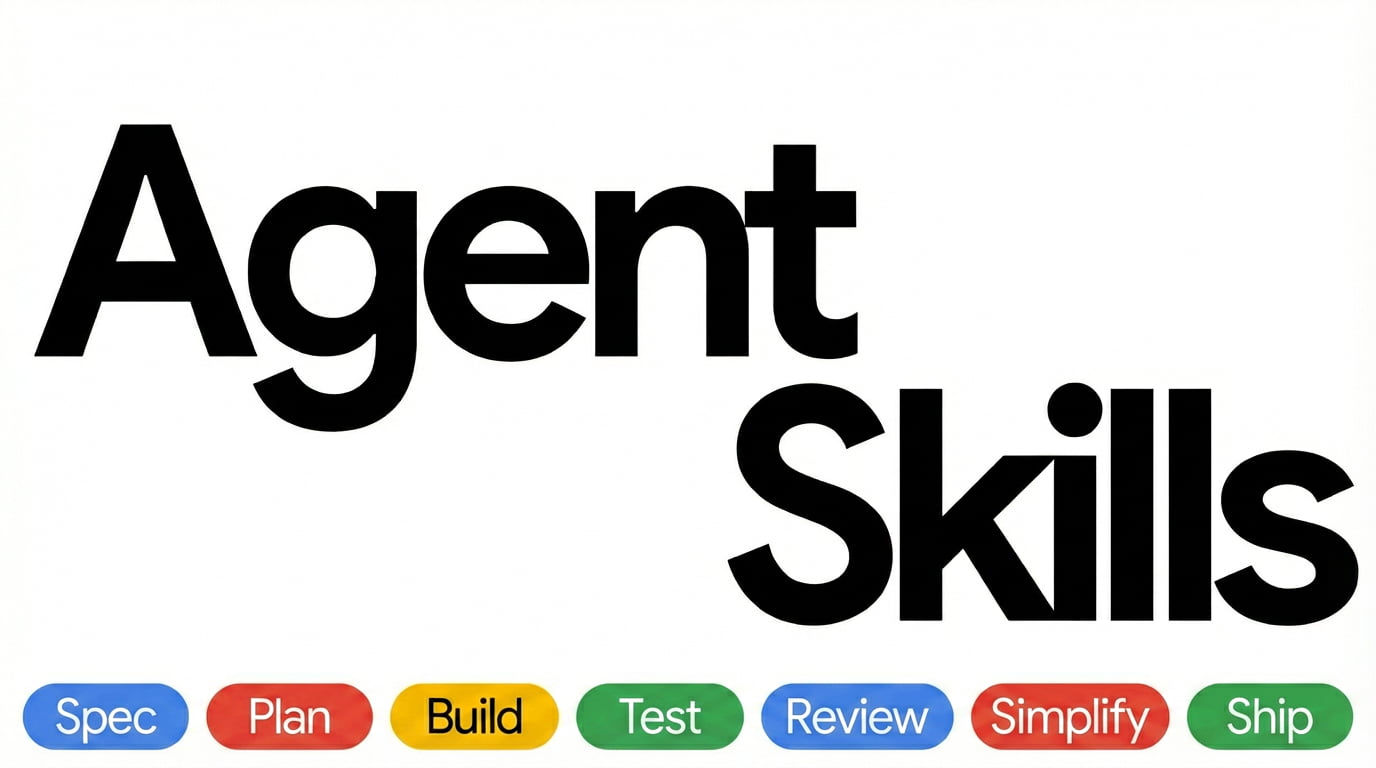
Why AI Coding Agents Need Senior Engineering Scaffolding: An Analysis of the Agent Skills Project
The 'Agent Skills' project, authored by Addy Osmani, addresses a fundamental flaw in current AI coding agents: their tendency to act like junior developers by prioritizing the shortest path to completion. While agents excel at generating code, they often bypass critical 'invisible' tasks such as writing specifications, creating tests, and ensuring code reviewability. Agent Skills introduces a framework of markdown-based 'skills' injected into an agent's context to enforce senior-level engineering discipline. By mapping these skills to established Software Development Life Cycles (SDLC) and Google’s engineering practices, the project aims to move AI beyond simple code generation toward reliable, scalable software engineering. With over 26,000 stars, the project highlights a significant industry demand for tools that bridge the gap between functional code and professional engineering standards.
Key Takeaways
- The Junior Failure Mode: AI coding agents naturally default to the shortest path to 'done,' often skipping essential non-code tasks like testing and documentation.
- Invisible Engineering: Senior engineering is defined by work that doesn't appear in a code diff, such as surfacing assumptions, writing specs, and maintaining scope discipline.
- The 'Agent Skills' Solution: A framework that uses markdown files with frontmatter to inject senior-level 'scaffolding' into an AI agent's context.
- Industry Alignment: The project maps AI workflows to standard Software Development Life Cycles (SDLC) and Google’s published engineering practices.
- High Community Adoption: The project has gained significant traction, surpassing 26,000 stars on GitHub, indicating a widespread need for disciplined AI coding.
In-Depth Analysis
The Gap Between Code Generation and Software Engineering
The core premise of the Agent Skills project is that a senior engineer’s value lies largely in the work that is not visible in the final code change (the 'diff'). This includes the creation of specifications, the development of comprehensive tests, and the rigorous review of code. AI coding agents, by default, lack this perspective. They operate on a reward signal that prioritizes 'task completion' over the long-term reliability and maintainability of the software.
When an AI agent is asked for a feature, it typically writes the feature and declares victory. It does not inherently ask for a specification, consider trust boundaries, or evaluate how the pull request (PR) will appear to a human reviewer. This behavior mirrors the failure modes of junior engineers who have not yet learned the importance of the 'invisible' scaffolding that supports reliable software at scale. Agent Skills is an attempt to 'bolt' this senior-level discipline back onto the AI's workflow.
Defining 'Skills' as Contextual Scaffolding
In the context of tools like Claude Code and the Anthropic vocabulary, a 'skill' is more than just a capability; it is a structured injection of context. Technically, a skill in this project is a markdown file equipped with frontmatter. This file is strategically injected into the AI agent’s context when specific situations arise.
This design choice ensures that the agent is not just 'pushing code that breaks' but is instead following a structured process. By providing this scaffolding, the agent is forced to consider the 'senior version' of a task. This includes breaking work into reviewable chunks, choosing 'boring' (and therefore more stable) designs, and leaving evidence that the resulting code is correct. The goal is to ensure that the agent's output is sized so that a human can actually review it, maintaining the integrity of the development process.
Mapping to Industry Standards and SDLC
One of the critical aspects of the Agent Skills project is its alignment with professional industry standards. The author notes that the design choices within the project map directly onto standard Software Development Life Cycles (SDLC) and Google’s published engineering practices. This alignment is crucial for integrating AI agents into professional environments where 'scope discipline' and the refusal to ship unverified code are mandatory.
The project emphasizes that even if a developer does not install the specific skills provided, the underlying philosophy—surfacing assumptions and leaving evidence of correctness—is something that should be 'stolen' or adopted. This suggests that the future of AI-assisted development lies not just in better models, but in better frameworks that enforce the rigorous standards of senior software engineering.
Industry Impact
The rapid adoption of the Agent Skills project, evidenced by its 26,000+ stars, signals a shift in the AI industry. There is a growing realization that raw code generation is insufficient for professional software development. The industry is moving toward a model where AI agents must be governed by the same 'scaffolding' that human senior engineers use to ensure reliability.
By formalizing 'skills' as markdown-based context injections, the project provides a blueprint for how AI can be integrated into complex, high-stakes engineering environments. This approach ensures that AI-generated code is not just functional but is also reviewable, tested, and aligned with organizational standards, potentially reducing the technical debt often associated with rapid, automated code generation.
Frequently Asked Questions
Question: What exactly is a "skill" in the Agent Skills project?
A skill is defined as a markdown file with frontmatter that is injected into an AI agent's context (such as Claude Code) when needed. It acts as a set of instructions or 'scaffolding' that guides the agent to follow specific engineering practices rather than just writing code.
Question: Why do AI agents tend to skip senior-level engineering tasks?
AI agents typically follow the shortest path to 'task complete' because their reward signals point toward finishing the requested feature. They often ignore 'invisible' tasks like writing specs or tests because these steps do not show up in the final code diff and are not part of their default behavior.
Question: How does Agent Skills help with code reviews?
Agent Skills encourages the agent to break work into reviewable chunks and to size changes so that a human can effectively review them. It also prompts the agent to leave evidence that the result is correct, making the review process more manageable and reliable for human engineers.

